
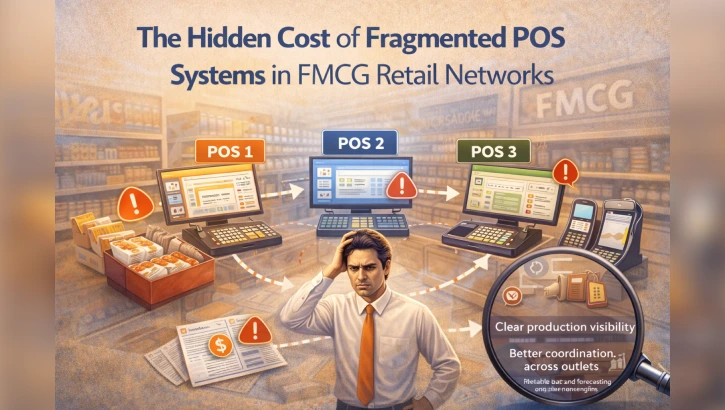
For FMCG brands, retail is where demand becomes revenue. This is especially true in high-scale markets like Tamil Nadu and South India, where FMCG ecosystems span staples, spices, dairy, edible oils, and personal care categories.
Brands operating at this scale such as staples and masala leaders like Aachi, Sakthi Masala, and MTR, dairy-focused enterprises similar to Hatsun, and edible oil or packaged food brands depend heavily on efficient retail execution. Yet many FMCG retail networks still operate on fragmented POS systems.
At first glance, these systems appear to work: billing happens, inventory moves, reports are generated. But beneath the surface, fragmentation creates hidden costs that silently erode efficiency, insight, and scalability.
For FMCG enterprises managing thousands of SKUs across distributors, supermarkets, and modern trade outlets, these hidden costs add up faster than most organizations realize.
Fragmented POS environments typically look like this:
- Different POS software across stores or regions
- POS systems not integrated with ERP or central inventory
- Manual data uploads and reconciliation
- Store-level reports that don’t align with enterprise data
This setup is common in FMCG-driven retail networks that have grown organically adding stores, distributors, or partners over time without a unified retail technology strategy. Many long-established South Indian FMCG groups have scaled distribution successfully, but retail systems often evolve unevenly along the way.
When POS systems operate in isolation, data becomes siloed at the store or partner level.
This leads to:
- Delayed visibility into sales performance
- Inconsistent SKU-level data across regions
- Inability to track real-time secondary and tertiary sales
For FMCG brands handling high-velocity categories such as staples and spices (Aachi, Sakthi Masala, MTR), dairy and perishables (Hatsun-style operations), and edible oils or packaged foods, even a small delay in sales visibility can distort demand forecasting and replenishment decisions.
Instead of acting on real consumption data, teams are forced to rely on historical snapshots and manual summaries.
Fragmented POS systems almost always require manual reconciliation.
Common symptoms include:
- Sales data not matching inventory movement
- Frequent adjustments during month-end closing
- Discrepancies between distributor, retailer, and enterprise reports
Operations, finance, and IT teams spend a disproportionate amount of time resolving data mismatches instead of focusing on growth, optimization, or strategy. This operational drag is frequently seen in FMCG retail networks that have expanded across regions and formats over many years.
Over time, this manual effort becomes normalized—yet it represents a significant, ongoing cost.
Perhaps the most damaging impact of fragmented POS systems is lost insight.
Without unified retail data, FMCG brands struggle to answer basic but critical questions:
- Which SKUs are actually driving growth at the store level?
- Where are stock-outs happening, and why?
- How effective are promotions across regions and formats?
For FMCG enterprises operating at scale especially those managing wide SKU portfolios across categories like food, dairy, oils, and personal care—these insight gaps don’t just slow decision-making. They lead to missed opportunities and reactive planning.
Fragmentation Breaks the AI and Analytics Promise
Many FMCG organizations talk about AI, advanced analytics, and predictive insights. But AI is only as good as the data feeding it.
Fragmented POS environments result in:
- Incomplete datasets
- Inconsistent data formats
- Delayed data availability
This makes it nearly impossible to apply AI meaningfully across demand forecasting, inventory optimization, or retail execution.
In practice, unified retail data not algorithms is the real foundation of intelligent FMCG operations, particularly for high-volume South Indian FMCG ecosystems.
Fragmentation becomes more expensive as FMCG brands grow.
As operations e xpand:
- SKU counts increase
- Store formats diversify
- Regional demand patterns vary more widely
What was manageable at 10 or 50 stores becomes unsustainable at hundreds or thousands. At this stage, the cost of not fixing retail fragmentation far exceeds the cost of modernizing systems.
Leading FMCG brands and retail networks are now moving toward unified POS and ERP platforms that provide:
- Real-time sales and inventory visibility
- Centralized pricing and SKU control
- Consistent reporting across stores and partners
- Seamless integration with enterprise systems
As FMCG portfolios grow in depth and geographic reach often seen in large regional groups across food, dairy, and personal care—unified retail platforms become essential to maintain control without adding operational complexity.
At Uniprotech, we see fragmented POS systems as one of the biggest blockers to scalable FMCG growth.
Our experience across large retail and enterprise environments shows that:
- Unified retail platforms reduce reconciliation effort dramatically
- Clean, real-time data enables better forecasting and execution
- Retail-first automation strengthens collaboration between brands and retailers
When POS, ERP, analytics, and inventory operate as one system, retail data stops being a reporting burden and becomes a strategic asset.
Fragmented POS systems don’t fail loudly. They fail quietly through inefficiency, lost insight, and slow decision-making.
For FMCG brands operating in competitive, high-velocity markets, these hidden costs compound over time.
The future of FMCG retail belongs to organizations that recognize this early—and invest in unified, retail-first systems that turn data into intelligence and scale into advantage.
Uniprotech builds enterprise-grade Retail POS, ERP, and automation platforms designed for FMCG and multi-store retail ecosystems. Our solutions help brands and retailers eliminate fragmentation, improve visibility, and scale operations with confidence.


Frequently Asked Auestions
A fragmented POS system refers to retail environments where different stores or regions use disconnected POS software that is not integrated with ERP or central inventory systems. This leads to data silos, manual reconciliation, and inconsistent reporting across the FMCG retail network.
Fragmented POS systems delay sales visibility, create inventory mismatches, and prevent FMCG brands from accessing real-time retail data. Over time, this results in lost insights, operational inefficiencies, and slower decision-making.
Data silos prevent FMCG enterprises from seeing accurate, consolidated sales and inventory information across stores and distributors. This affects demand forecasting, replenishment planning, promotion effectiveness, and overall retail execution.
Manual reconciliation consumes significant time across finance, operations, and IT teams. It increases the risk of errors, delays month-end closing, and diverts resources away from growth, optimization, and strategic initiatives.
AI and advanced analytics depend on clean, consistent, and real-time data. Fragmented POS systems produce incomplete and delayed datasets, making it difficult to apply AI effectively for forecasting, inventory optimization, and retail performance analysis.
A unified POS and ERP platform provides real-time visibility into sales, inventory, and pricing across all stores and partners. It eliminates data silos, reduces reconciliation effort, and creates a single source of truth for enterprise-wide decision-making.
While large FMCG enterprises benefit the most, unified retail automation is also valuable for growing regional brands. Scalable POS and ERP platforms allow businesses to modernize incrementally as their retail networks expand.
FMCG brands can begin by standardizing POS systems across key retail partners, integrating POS with ERP and inventory systems, and adopting retail-first automation platforms that support phased deployment.