
Menu
Why 1 in 4 Cloud Kitchens in India Shut Down in Their First Year and It Is Rarely the Food
A complete guide for cloud kitchen owners and multi-brand virtual restaurant operators across India
Section 1: The Cloud Kitchen Boom and the Reality Check Behind It
India’s cloud kitchen industry has grown into a genuine and significant part of the country’s restaurant economy. The sector is valued in the range of Rs 3,200 crore to over Rs 9,000 crore depending on which industry estimate you reference, with most analysts projecting continued double-digit annual growth through the rest of this decade. Bangalore leads the country in cloud kitchen density, followed closely by Delhi NCR, Mumbai, Hyderabad, and Chennai. The appeal is obvious: no expensive dine-in real estate, no front-of-house staffing, lower setup costs, and the ability to launch a new food brand in days rather than months.
For a first-time food entrepreneur, the cloud kitchen model can look like the easiest possible entry into the restaurant business. Rent a small kitchen space, register on Zomato and Swiggy, launch a menu, and start receiving orders within weeks.
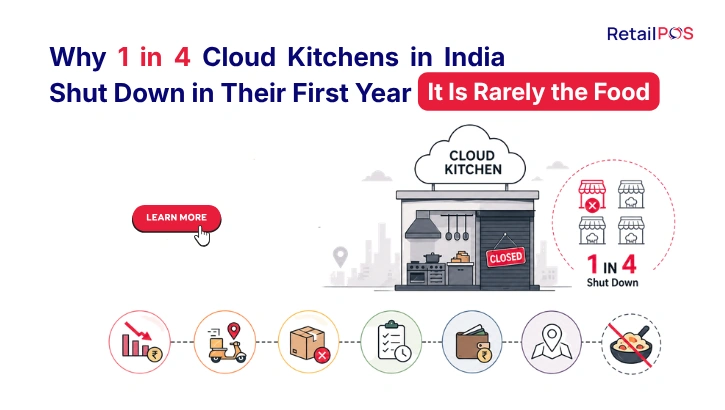
The reality has turned out to be considerably harder than this picture suggests. Across the sector, an estimated 25 to 30 percent of cloud kitchens close within their first year of operation, and in several metro markets nearly half of all operating cloud kitchens struggle to remain profitable even after surviving that first year. High-profile cloud kitchen operators have shut down or scaled back their ambitions after discovering that real-world rents and utility costs ran well above what their initial projections assumed.
The uncomfortable truth that most new cloud kitchen owners discover only after they have already invested their capital is this: cloud kitchens rarely fail because the food is bad. They fail because of a specific, repeatable set of operational and financial mistakes that have nothing to do with cooking skill and everything to do with how the business is run behind the scenes.
This guide walks through exactly what those mistakes are, what they cost in real terms, and what the cloud kitchens that do survive and scale are doing differently.
Section 2: The Numbers Nobody Tells You Before You Sign the Lease
Before getting into the operational causes of cloud kitchen failure, it is worth being honest about the financial baseline that every cloud kitchen operator is working against from day one.
Cost or Metric | Typical Range in India | Why It Matters |
Initial setup cost | Rs 3 lakh to Rs 15 lakh depending on shared versus standalone kitchen | Shared kitchens reduce risk but limit control over operations and brand identity |
Aggregator commission per order | 25 to 35 percent of order value | This is taken before food cost, packaging, rent, or staff are accounted for |
Typical gross margin (well-managed kitchen) | 20 to 40 percent | Looks healthy on paper but depends entirely on controlling the variables below |
Net margin (small, single-brand kitchen) | 10 to 15 percent | Thin enough that a single bad month of ingredient inflation or rating drop erases profit entirely |
Net margin (well-managed multi-brand kitchen) | 20 to 25 percent | Achievable, but only with the operational discipline described later in this guide |
First-year closure rate across the sector | 25 to 30 percent | Most closures are operational and financial, not culinary |
The gap between a 10 to 15 percent net margin and a 20 to 25 percent net margin is not a difference in food quality. It is almost entirely a difference in how the business is operated: how many brands are run from the kitchen, how tightly inventory and food cost are controlled, how dependent the kitchen is on aggregator-driven discounting, and how well multiple order channels are coordinated during peak hours.
Section 3: The Five Real Reasons Cloud Kitchens Fail in India
3.1 Underestimating the True Cost of Running the Kitchen
Many first-time cloud kitchen operators assume that avoiding dine-in rent automatically guarantees high profitability. In practice, real estate and utility costs for commercial kitchen space have frequently run well above initial projections, in some documented cases 50 to 70 percent higher than what new operators budgeted for. Combined with packaging costs, which directly affect both unit economics and the customer’s delivery experience, and with the heavy promotional discounting that most aggregator platforms expect new listings to run in order to gain visibility, the actual cost structure of a cloud kitchen in its first few months is almost always heavier than the founder’s initial spreadsheet suggested.
3.2 Treating Multiple Brands as Multiple Headaches Instead of One Coordinated System
The multi-brand cloud kitchen model, where a single kitchen operates three to five or even more virtual restaurant brands simultaneously, is one of the most effective ways to improve kitchen utilisation and spread fixed costs across more revenue. Leading multi-brand operators run as many as 15 different brands from shared locations specifically to maximise this efficiency.
But this model only works when every brand’s orders, inventory consumption, and kitchen capacity are managed through one coordinated system. When each virtual brand is treated as a separate operation with its own informal tracking, the kitchen quickly loses visibility into which brand is actually profitable, which shared ingredients are being consumed by which brand, and whether the kitchen has the capacity to accept a new order for Brand C while Brand A and Brand B are both running at peak volume.
3.3 Oversupply and Brand Sameness
Because the barrier to launching a new virtual brand is so low, many cloud kitchen operators launched multiple brands targeting similar cuisines that ended up differentiated by little more than name and menu photography. This created markets saturated with near-identical offerings, which drove up customer acquisition costs and made repeat ordering harder to earn, since customers had little genuine reason to remain loyal to one brand over a nearly identical competitor.
3.4 Complete Dependence on Aggregator Platforms
Most independent cloud kitchens generate 80 to 90 percent of their orders through Zomato and Swiggy. These platforms charge commission rates of 25 to 35 percent per order, and because the aggregators control customer discovery, search ranking, and the visibility algorithm, a kitchen has very limited ability to build a direct relationship with its own customers. A kitchen earning Rs 3 lakh in monthly gross revenue may retain only Rs 1.8 to 2.2 lakh after commission alone, before food cost, rent, packaging, or staff salaries are even factored in.
This dependency becomes especially dangerous when an aggregator changes its commission structure, adjusts its ranking algorithm, or runs a promotional campaign that forces participating kitchens into discounting they did not choose. A kitchen with no direct ordering channel and no loyal customer base outside the aggregator ecosystem has no buffer against these changes.
3.5 Inconsistent Food Quality and Delivery Reliability at Scale
As order volume grows, particularly across multiple brands from the same kitchen, maintaining consistent food quality and reliable delivery timing becomes significantly harder without standardised systems. Late deliveries, incorrect orders, and poor packaging directly damage customer trust, and because a cloud kitchen has no physical storefront where a customer can form a positive in-person impression to offset an occasional bad delivery experience, every single negative review carries disproportionate weight on the platforms that control the kitchen’s visibility.
Section 4: Why Multi-Brand Management Is Where Most Cloud Kitchens Actually Break
The multi-brand model is simultaneously the biggest opportunity and the biggest operational risk in the Indian cloud kitchen industry today. Understanding exactly where it breaks down is essential for any operator running, or planning to run, more than one virtual brand from a single kitchen.
The shared ingredient blindspot. When Brand A’s biryani and Brand B’s North Indian thali both use the same marinated chicken base, a kitchen tracking inventory separately per brand, or not tracking it systematically at all, has no way of knowing in real time how much of that shared ingredient remains available across both brands combined. The kitchen can accept orders for both brands simultaneously without realising the combined demand has already exceeded available stock.
The capacity collision problem. During a Friday evening peak, Brand A might be running biryani orders, Brand B might be running thali orders for the same time slot, and a third weekend-only pizza brand might also be active. Without a single, unified view of total kitchen capacity across every active brand, an operator has no reliable way to know whether accepting one more order from any brand will push total preparation time beyond what the kitchen can deliver on time.
The profitability fog. Leading multi-brand kitchens succeed because they know exactly which brand contributes the most margin per order, not just the most total revenue. Without recipe-level cost tracking applied consistently across every brand, an operator can be pouring marketing effort and kitchen capacity into the brand that looks busiest on the surface while it is actually the least profitable brand in the portfolio.
The pricing and promotion chaos. Each brand typically runs its own pricing, its own combo offers, and its own promotional campaigns on Zomato and Swiggy. Without centralised management of these settings, price changes get missed, expired promotions continue running at a loss, and brands end up competing against each other for the same customer search results rather than complementing one another.
Section 5: The Aggregator Dependency Trap and How It Compounds Every Other Problem
Every one of the five failure causes described above becomes significantly more dangerous when combined with heavy aggregator dependency, and this combination is exactly what most struggling cloud kitchens in India are experiencing simultaneously.
Consider the compounding effect. A kitchen running three brands without unified inventory tracking experiences a mid-service stockout on a shared ingredient. Because the kitchen has no direct ordering channel, the only customers affected are aggregator customers, and a stockout-driven order cancellation on Zomato or Swiggy does not just cost that single order. It damages the kitchen’s cancellation rate metric, which the platform’s algorithm uses to determine future search visibility. A lower search ranking means fewer future orders across all three brands, which means the kitchen has less revenue to absorb the next operational mistake, which makes the kitchen even more dependent on aggregator-driven discounting to maintain order volume, which compresses margins further.
This is precisely why the surviving and scaling cloud kitchens in India have made reducing aggregator dependency a deliberate strategic priority, building their own ordering websites and apps, launching subscription models for repeat customers, and using loyalty programmes to convert aggregator-acquired customers into direct, repeat business that does not carry a 25 to 35 percent commission on every single order.
Section 6: The Problem vs Solution Breakdown
Cloud Kitchen Failure Cause | Why It Happens | Technology Solution |
Underestimated operating costs | No real-time visibility into actual food cost, packaging cost, and utility cost per order | Recipe-level cost tracking showing true cost and margin per dish per brand in real time |
Multi-brand inventory blindspot | Shared ingredients not tracked centrally across brands sharing one kitchen | Centralised inventory deducting shared ingredient stock automatically regardless of which brand’s order consumed it |
Kitchen capacity collision during peak hours | No unified view of total order volume across all active brands simultaneously | Single kitchen display system showing every order from every brand and every channel in one prioritised queue |
Profitability fog across multiple brands | No brand-level margin reporting, only total revenue visibility | Per-brand profitability reporting showing actual margin after commission, packaging, and food cost |
Pricing and promotion chaos across brands | Each brand’s pricing managed separately and inconsistently | Centralised menu and pricing management across all brands from one dashboard |
Total aggregator dependency | No direct ordering channel or customer retention mechanism outside Zomato and Swiggy | Customer loyalty and repeat-order tracking that builds a direct customer relationship independent of aggregator visibility |
Inconsistent quality and delivery reliability at scale | No standardised recipe or preparation time tracking as order volume grows | Standardised recipe management and preparation time data that holds quality consistent regardless of order volume |
Section 7: What the Surviving Cloud Kitchens Are Doing Differently
The cloud kitchen operators who have moved past the early, high-failure phase of the industry and built sustainable, scaling businesses share a consistent set of operational habits.
They stopped launching brands experimentally and instead concentrated on a smaller number of cuisine concepts with genuine repeat-order potential, rather than spreading kitchen capacity and marketing budget across many near-identical virtual brands. They invested in centralised production and procurement, allowing better supplier terms and tighter cost control across whatever brand portfolio they did run. Many built loyalty programmes or subscription models specifically to reduce dependence on aggregator-driven discovery. And across the board, the businesses that survived replaced blind, rapid expansion with operational discipline: better forecasting, tighter cost control, and centralised systems that gave the founder a single, accurate view of how the entire kitchen, across every brand, was actually performing.
This shift from instinct-driven growth to data-driven, centrally managed operations is the single clearest difference between the cloud kitchens that are closing within their first year and the ones that are still scaling profitably several years in.
Section 8: How RetailPOS Dineazy Solves the Operational Side of Cloud Kitchen Survival
RetailPOS Dineazy is built to give Indian cloud kitchen operators exactly the centralised, data-driven operational foundation described above, regardless of how many virtual brands are running from a single kitchen.
Unified multi-brand order management. Every order from every brand, across Zomato, Swiggy, and any direct ordering channel, arrives in one kitchen display queue organised by preparation time and urgency, eliminating the multi-screen chaos of managing separate brand tablets during peak service.
Centralised inventory across shared ingredients. When Brand A’s biryani and Brand B’s thali both draw from the same marinated chicken stock, Dineazy deducts that shared ingredient from one live inventory count regardless of which brand’s order consumed it, eliminating the shared ingredient blindspot that causes mid-service stockouts and order cancellations.
Recipe-level cost and margin tracking per brand. Every dish across every brand is mapped to its exact ingredient cost. Dineazy reports actual margin per brand after commission, packaging, and food cost, replacing the profitability fog that causes operators to invest effort in the brand that looks busiest rather than the one that is actually most profitable.
Centralised pricing and promotion management. Menu pricing, combo offers, and promotional campaigns across every brand are managed from one dashboard, with automatic activation and expiry, removing the pricing chaos that causes missed updates and brands competing against each other.
Demand forecasting to avoid capacity collisions. Dineazy analyses historical order patterns by day, time slot, and brand to recommend prep quantities and flag when combined demand across all active brands is approaching the kitchen’s real preparation capacity, before a customer order is accepted that the kitchen cannot deliver on time.
Customer loyalty tools to reduce aggregator dependency. Direct customer relationship and loyalty tracking helps cloud kitchens build the repeat-order base that the surviving operators in this sector have prioritised, converting aggregator-acquired customers into a direct relationship that does not carry a recurring commission on every order.
Conclusion: The Kitchens That Survive Are Run, Not Just Cooked
India’s cloud kitchen industry is not a story of failure. It is a genuinely large and growing part of the country’s restaurant economy, and the demand driving it, urban Indians ordering food online every week, is not slowing down. But the sector has matured past the point where a good menu and a Zomato listing are enough on their own.
The cloud kitchens shutting down in their first year are overwhelmingly failing on operations and economics, not on cooking. Underestimated costs, multi-brand chaos, oversupply of near-identical concepts, and total dependence on aggregator platforms are all problems that exist independently of how good the food actually is. And every one of them is a problem with a specific, addressable solution rooted in centralised, real-time visibility into what is actually happening across every brand, every order, and every rupee of cost in the kitchen.
The operators who treat their cloud kitchen as a system to be managed with the same rigour as any other business, rather than a low-cost experiment to be run on instinct, are the ones building the 20 to 25 percent margin multi-brand operations that the rest of the industry is still struggling to reach.


Frequently Asked Questions
Industry data shows a single kitchen can typically operate three to five virtual brands effectively, with some leading multi-brand operators running considerably more from shared locations. The right number depends on kitchen size, staffing, and crucially, whether the operator has a centralised system to manage shared ingredients and combined order capacity across every brand. Without that system, even two or three brands can quickly become unmanageable during peak hours.
Small, single-brand cloud kitchens typically see net margins of around 10 to 15 percent, while well-managed multi-brand kitchens can reach 20 to 25 percent or higher. The gap between these two outcomes is driven almost entirely by operational discipline: tight food cost control, centralised inventory across shared ingredients, and reduced dependence on aggregator commission and discounting, not by differences in recipe quality.
Most independent cloud kitchens generate 80 to 90 percent of their orders through aggregator platforms, which charge commission rates of 25 to 35 percent per order. This means a kitchen generating Rs 3 lakh in monthly gross revenue through aggregators alone may retain only Rs 1.8 to 2.2 lakh after commission, before any other cost is deducted, which is why building a direct ordering channel and customer loyalty programme is a priority for kitchens aiming to improve long-term profitability.
Yes, but the strategy that succeeds in 2026 looks different from the early, experimental phase of the industry. Rather than launching many similar brands to test the market, successful operators are concentrating on a smaller number of genuinely differentiated cuisine concepts with real repeat-order potential, supported by centralised systems that give full visibility into shared inventory, combined kitchen capacity, and per-brand profitability.
Yes. Dineazy is fully suited to delivery-only cloud kitchen operations with no dine-in component. The system manages multi-brand order intake from aggregator platforms and direct channels, recipe-level inventory across shared ingredients, kitchen display integration, and per-brand profitability reporting, all without requiring any dine-in or table management functionality that a cloud kitchen does not need.
About RetailPOS
RetailPOS is an enterprise restaurant and retail POS solution by Unipro Tech Solutions Pvt Ltd, headquartered in Chennai, Tamil Nadu. With over 20 years of experience and 10,000 plus businesses served across India and globally, RetailPOS provides purpose-built technology for restaurant, cloud kitchen, retail, and distribution businesses. Restaurant products include Dineazy, KDS, Kitchenserve, Kioskserve, QSR+, QR+, and the Cockpit multi-outlet dashboard.