
Asset Tracking System in India: Why Manufacturers and Warehouses Are Losing Crores Without One in 2026
A complete guide for Indian manufacturers, warehouse operators, logistics companies, and industrial businesses evaluating asset tracking systems
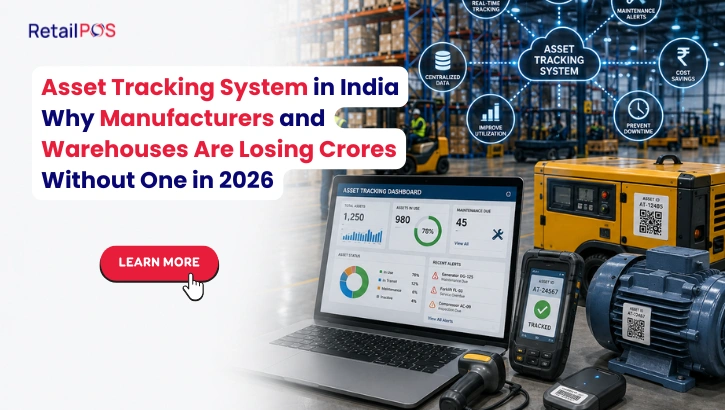
Section 1: The Asset Problem Every Indian Manufacturer and Warehouse Has But Cannot See
Ask any production manager at an Indian manufacturing facility how many tools, machines, and pieces of equipment are currently in active use on the shop floor versus sitting idle in storage versus under maintenance versus simply missing, and most will not be able to tell you with any precision.
Ask a warehouse manager at an Indian distribution hub how many forklifts, pallet jacks, scanning guns, and trolleys are currently deployed, where each one is, and which are overdue for maintenance, and the answer will be similar.
This is not because these managers are not doing their jobs. It is because without an asset tracking system, this information simply does not exist in real time. It exists in a maintenance register that was last updated three weeks ago. It exists in a spreadsheet that the procurement team built and nobody else uses. It exists in the floor supervisor’s memory and nowhere else.
Asset tracking is no longer nice to have. In 2026 it is the difference between operations that run on guesswork and operations that run on data.
For Indian manufacturers and warehouse operators, the stakes are significant. Most facilities still manage equipment with spreadsheets, outdated systems, or manual paper logs that create blind spots in asset visibility, inflate maintenance costs, and accelerate unexpected breakdowns. The financial consequence of this is not abstract. Every hour a production line is stopped because a critical tool cannot be located, every piece of equipment that goes out for use and never comes back, every maintenance schedule that slips because nobody was tracking the asset’s usage hours, represents a direct rupee loss that a properly implemented asset tracking system would have prevented.
This guide explains exactly what an asset tracking system does, who needs one in India, what it costs to operate without one, and what to look for when choosing the right solution for your specific operation.
Section 2: What an Asset Tracking System Actually Is and What It Does
An asset tracking system is software and in some configurations hardware that monitors the location, status, condition, and history of physical assets across a facility or network of facilities in real time.
The term asset covers an enormous range of physical items depending on the industry:
Industry | Assets Tracked |
Manufacturing | CNC machines, tools, jigs, fixtures, moulds, forklifts, measuring instruments |
Warehouse and logistics | Forklifts, pallet jacks, trolleys, scanning guns, pallets, dock equipment |
Healthcare | Medical equipment, beds, wheelchairs, oxygen cylinders, surgical instruments |
Construction | Heavy equipment, vehicles, scaffolding, tools, generators |
IT and offices | Laptops, servers, monitors, mobile devices, printers |
Retail chains | POS terminals, tablets, scanners, display units across multiple outlets |
Pharma and food | Production equipment, containers, cold chain units, calibration instruments |
What an asset tracking system does at the most basic level:
- Maintains a digital register of every tracked asset with its ID, location, and status
- Records every movement of every asset from one location to another
- Tracks which person or department has each asset checked out at any time
- Alerts when an asset has been in one location longer than expected
- Generates reports showing asset utilisation, location history, and maintenance status
What a sophisticated asset tracking system additionally does:
- Triggers maintenance alerts based on usage hours or time since last service
- Integrates with the organisation’s ERP to link asset data with financial depreciation records
- Provides real-time dashboards showing all assets across all locations simultaneously
- Tracks the full lifecycle of every asset from procurement through disposal
- Calculates actual asset utilisation versus available capacity to identify underused and overused equipment
Section 3: How an Asset Tracking System Works: The Complete Flow
Stage | What Happens Physically | What the System Does |
Asset registration | New equipment arrives at facility | Asset entered with ID, specifications, location, purchase cost, and expected lifespan |
Tagging | Asset is labelled with barcode, QR code, or RFID tag | Tag linked to asset record in system database |
Deployment | Asset moves from storage to active use | Scan records departure from storage, records destination location and assigned user |
In-use tracking | Asset is in active use at facility | Location and status visible on dashboard in real time |
Movement | Asset moves between locations or departments | Scan at movement point updates location record instantly |
Maintenance trigger | Usage hours reach configured threshold | Maintenance alert fires automatically to responsible team |
Maintenance completion | Maintenance performed | Maintenance record logged against asset, next service scheduled |
Return | Asset returned from use | Scan records return, updates availability status |
Disposal | Asset reaches end of useful life | Disposal recorded, depreciation record closed, replacement triggered |
This lifecycle tracking is what converts a static asset register, which every business already maintains for accounting purposes, into a live operational intelligence system that tells management where every asset is, what condition it is in, and whether it is being used efficiently.
Section 4: Who Needs an Asset Tracking System in India in 2026
The short answer is: any Indian business that owns physical assets worth tracking and is currently managing them manually.
Business Type | Signal That Asset Tracking Is Needed | Specific Risk Without It |
Manufacturing plants | Production stoppages due to missing tools or equipment | Every hour of unplanned downtime costs Rs 50,000 to Rs 5 lakh depending on the production value |
FMCG and pharma distributors | Forklifts and warehouse equipment going out of service unexpectedly | Manual operations during equipment downtime, order fulfilment delays |
Multi-outlet retail chains | POS terminals, scanning guns, and tablets unaccounted across outlets | Capital loss from unreturned or misplaced equipment across locations |
Construction companies | Heavy equipment spread across multiple sites | Idle equipment on one site while another site pays for rental |
IT companies and BPOs | Laptops and devices across large employee bases | Unrecovered equipment at employee exit, audit compliance gaps |
Hospitals and healthcare | Medical devices and equipment across wards and departments | Equipment unavailable when needed, maintenance compliance gaps |
Logistics companies | Vehicles, pallets, and material handling equipment across facilities | Low asset utilisation, maintenance delays, replacement before necessary |
The businesses that benefit most immediately from an asset tracking system are the ones where equipment downtime has a direct and measurable cost to operations. In Indian manufacturing, where production targets are directly linked to equipment availability, this connection is clearest and the ROI from asset tracking is most immediate.
Section 5: The Seven Specific Problems an Asset Tracking System Solves
5.1 Equipment That Cannot Be Found When It Is Needed
Misplaced tools, components, or raw materials are among the most common and most disruptive problems in Indian manufacturing and warehouse operations. A CNC operator who needs a specific calibration tool and spends 45 minutes searching the facility before finding it in the wrong department is not a productivity failure. It is a system failure. The tool was not tracked, so nobody knew where it was.
An asset tracking system solves this by maintaining a real-time location record for every tracked asset. The moment someone needs a specific piece of equipment, the dashboard shows exactly where it is, who has it, and whether it is available.
5.2 Maintenance Schedules That Nobody Is Actually Following
Equipment maintenance in most Indian manufacturing and warehouse facilities is managed through a combination of the equipment manufacturer’s recommended schedule, the maintenance team’s experience, and the production team’s willingness to release equipment for service. In practice, production pressure almost always wins over maintenance schedules, and maintenance that slips silently becomes equipment failure that arrives loudly.
An asset tracking system tracks usage hours or calendar intervals for every asset and triggers maintenance alerts automatically when the configured threshold is reached. The maintenance team receives the alert. The production schedule is informed in advance. Planned maintenance replaces unplanned breakdown.
5.3 Assets That Leave the Facility and Never Return
In Indian business environments, equipment that is checked out by a staff member or contractor and not tracked formally has a significantly higher probability of not being returned than equipment that is formally recorded on departure and followed up on when not returned within the expected window.
A tool, a scanning gun, a laptop, or a piece of production equipment that leaves a facility without being tracked represents an asset write-off that rarely appears in any report because the item simply becomes gradually absent rather than formally lost.
An asset tracking system records every asset departure with the person responsible, the expected return date, and generates an overdue alert when the return does not happen on schedule.
5.4 Asset Utilisation That Nobody Is Measuring
Indian manufacturers and warehouse operators routinely purchase new equipment while existing equipment of the same type sits underutilised in a different department or a different facility. Without asset tracking data showing actual utilisation rates per asset type, procurement decisions are made on the basis of departmental requests rather than evidence of genuine need.
Real-time tracking provides instant visibility of parts, assets, and equipment across the shop floor, allowing teams to remove bottlenecks quickly and improve productivity through better equipment utilisation.
An asset tracking system generates utilisation reports showing, for every tracked asset category, how many hours per day or per week the asset is in active use versus idle. This data directly informs procurement decisions: if the utilisation data shows that existing forklifts are idle for an average of 4 hours per day, the request to buy additional forklifts can be evaluated against real usage evidence.
5.5 Audit and Compliance Gaps in Fixed Asset Records
Every Indian company is required to maintain accurate fixed asset records for financial reporting, depreciation calculation, and tax compliance. The physical assets in the accounting register must match the physical assets that can actually be located and accounted for in the facility.
In practice, discrepancies between accounting records and physical reality accumulate over time as assets are retired informally, relocated without documentation, or lost without formal write-off. Audit season in Indian companies often involves frantic physical searches for assets listed in the accounts that cannot be located.
An asset tracking system maintains a continuously updated digital record of every tagged asset, its location, and its condition, providing an audit-ready asset register that reduces physical audit time dramatically and eliminates the discrepancies that create compliance exposure.
5.6 No Visibility Into Assets Across Multiple Locations
For Indian businesses operating across multiple factory floors, warehouse locations, branch offices, or retail outlets, managing assets across locations without a centralised tracking system means each location maintains its own incomplete records with no shared visibility.
A manufacturing group with production facilities in Chennai, Pune, and Ahmedabad has no consolidated view of total equipment across all three facilities without an asset tracking system. Equipment that is surplus at Chennai and needed in Pune sits idle in one facility while the other facility rents or purchases a replacement.
An asset tracking system provides a single dashboard showing all assets across all locations simultaneously, enabling intelligent reallocation decisions before additional capital is deployed.
5.7 Reactive Maintenance Creating Production Disruptions
Spreadsheets and manual logs create blind spots in asset visibility, inflate maintenance costs, and accelerate unexpected breakdowns. The most expensive maintenance event in any manufacturing or logistics facility is the unexpected breakdown during active production or a critical delivery window.
Preventive maintenance driven by usage tracking and maintenance history eliminates the majority of unexpected breakdowns by ensuring every piece of equipment is serviced before it is stressed to the point of failure.
Section 6: The Real Rupee Cost of Running Without an Asset Tracking System
Cost Category | How It Manifests | Estimated Annual Impact |
Unplanned equipment downtime | Production line stopped due to equipment failure that preventive maintenance would have caught | Rs 5 lakh to Rs 2 crore depending on production value per hour |
Asset search time | Staff spending 20 to 60 minutes per instance locating misplaced tools or equipment | Rs 3 to Rs 8 lakh in annual productive hours consumed by searching |
Unreturned assets | Equipment checked out by staff or contractors and not returned | Rs 2 to Rs 10 lakh per year for medium-size manufacturing operation |
Over-procurement | Purchasing new equipment of a type already owned but not tracked or utilised | Rs 5 to Rs 25 lakh in preventable capital expenditure |
Audit preparation | Staff time and CA time reconciling physical assets against accounting records | Rs 1 to Rs 5 lakh annually in audit preparation effort |
Maintenance cost inflation | Reactive maintenance costs 3 to 5 times more than preventive maintenance | Rs 3 to Rs 15 lakh annually in excess maintenance spend |
Compliance exposure | Fixed asset register discrepancies creating audit findings | Variable, potentially significant penalty exposure |
For a medium-size Indian manufacturing company with a total asset base of Rs 5 to Rs 15 crore, the combined annual cost of operating without an asset tracking system routinely exceeds the annual cost of implementing one by a factor of 3 to 10.
Section 7: Asset Tracking Technology: Barcode, QR, RFID, GPS and IoT Explained
Different asset tracking technologies are appropriate for different types of assets and different operating environments. Understanding the options helps in choosing the right configuration for your specific operation.
Technology | How It Works | Best For | Key Limitation |
Barcode | Linear barcode on asset label, scanned by handheld reader | Low-cost, low-mobility assets in controlled environments | Requires line-of-sight scan, one asset at a time |
QR Code | Two-dimensional code on label, scanned by smartphone or reader | Low-cost, flexible deployment, mobile-friendly | Requires line-of-sight, cannot be read through packaging |
RFID | Radio frequency tag on asset, read by RFID reader at short to medium range | High-volume environments, assets passing through choke points | Higher cost per tag, reader infrastructure investment |
GPS | GPS tracker attached to or embedded in asset | Outdoor, mobile, or vehicle assets | Requires power source, does not work indoors accurately |
BLE (Bluetooth Low Energy) | Bluetooth beacon on asset, detected by receiver network | Indoor location tracking, tool tracking in large facilities | Requires BLE receiver infrastructure, proximity accuracy |
IoT Sensors | Sensor attached to asset monitoring condition in real time | High-value equipment where condition monitoring matters | Higher cost, more complex implementation |
For most Indian SME manufacturers and warehouse operators, a combination of QR code or barcode for basic asset identification with a cloud-based software platform for tracking, reporting, and maintenance management provides the best balance of capability and cost.
Section 8: What to Look For When Choosing an Asset Tracking System in India
Requirement 1: India-specific deployment and support.
An asset tracking system purchased from an international vendor with no India presence may deliver the software but leave you without local implementation support, local integration expertise, and local on-site service when something needs hands-on attention. Choose a vendor with proven Indian deployments and local support capability.
Requirement 2: Mobile-first field scanning.
In Indian manufacturing and warehouse environments, asset movements happen on the shop floor, in the warehouse, at loading docks, and in the field. Staff need to record asset movements from a mobile device, not from a desktop computer in an office. The system must have a mobile application that works offline in areas without strong connectivity.
Requirement 3: Integration with existing ERP or billing system.
An asset tracking system that operates as a completely separate island of data adds administrative overhead rather than reducing it. The system should integrate with your existing ERP, accounting software, or RetailPOS platform so that asset data enriches your existing operational and financial records rather than requiring a separate parallel administration.
Requirement 4: Configurable maintenance alerts.
Different assets have different maintenance schedules. Some are time-based (every 3 months), some are usage-based (every 500 operating hours), and some are condition-based (when a sensor reading crosses a threshold). The system must support all of these alert types and allow configuration per asset type or per individual asset.
Requirement 5: Multi-location visibility.
If your business operates across more than one facility, the asset tracking system must provide a consolidated view across all locations from one dashboard. Single-location systems that require manual data consolidation across facilities defeat a significant part of the purpose.
Requirement 6: Scalability from small to large asset bases.
Choose a system that can start tracking the most critical 50 assets in your facility and scale to tracking 5,000 assets across multiple locations as your implementation matures. The software architecture must support this scaling without requiring a system replacement.
Section 9: How Unipro Tech’s Asset Tracking System Serves Indian Businesses
Unipro Tech Solutions, headquartered in Chennai with over 20 years of experience serving Indian businesses across retail, distribution, and industrial operations, provides an Asset Tracking System built specifically for Indian manufacturing, warehouse, and industrial business environments.
Core capabilities of Unipro Tech’s Asset Tracking System:
Real-time asset location visibility. Every tracked asset’s current location is visible on a centralised dashboard accessible from any device. A production manager can see where every tool and piece of equipment is on the shop floor without leaving their desk. A multi-facility operations director can see the asset position across every site simultaneously.
Complete asset lifecycle management. Every asset is tracked from the moment it is purchased and registered through deployment, maintenance, relocation, and eventual disposal. The complete history of every asset — where it has been, who has used it, what maintenance has been performed — is available at any time from the asset’s record.
Maintenance scheduling and alerts. Maintenance schedules are configured per asset type based on time intervals, usage hours, or any other relevant parameter. Alerts fire automatically to the maintenance team before the scheduled date with enough lead time to plan the maintenance event without disrupting production.
Mobile-first scanning and updates. Field staff can record asset movements, confirm asset locations, and update asset status from a mobile device without returning to a desktop system. The mobile application works offline in low-connectivity environments and synchronises when connectivity is available.
Integration with RetailPOS and ERP systems. For businesses using RetailPOS for retail or distribution operations, the Asset Tracking System integrates natively, allowing assets across both operational and industrial functions to be managed from the same Unipro Tech platform with unified reporting.
Multi-location dashboard. For manufacturing groups and distribution businesses with multiple facilities, the dashboard provides a consolidated view of all assets across all locations simultaneously. Asset transfers between facilities are tracked with full documentation and both sending and receiving locations update automatically.
Audit-ready asset register. The digital asset register generated by the system is continuously updated and provides audit-ready records of every asset including purchase date, cost, location, condition, and maintenance history. Annual physical audits that previously took days are completed in hours when every asset has a scannable tag linked to a complete digital record.
Conclusion: The Assets Your Business Cannot See Are the Assets Your Business Cannot Manage
Every Indian manufacturer, warehouse operator, and multi-location industrial business has physical assets that are critical to operations. The question is not whether these assets matter. They clearly do, because when they fail, go missing, or are unavailable when needed, the operational and financial consequences are immediate and measurable.
The question is whether the business has the visibility to manage these assets proactively or only discovers asset-related problems reactively, after the production stoppage, after the equipment fails, after the audit finds the discrepancy, after the asset that left the facility was never returned.
An asset tracking system converts reactive asset management into proactive asset management. It does this not by adding complexity to operations but by adding visibility — the real-time, accurate, location-specific visibility that makes every asset decision from maintenance scheduling to equipment allocation to capital procurement a data-driven decision rather than a guess.
In 2026 the difference between operations that run on guesswork and operations that run on data is an asset tracking system. For Indian businesses managing significant physical asset bases, this is the year to make that shift.


Book a free demo and see how RetailPOS helps your supermarket chain bring fresh produce and perishable wastage under control.
Frequently Asked Questions
The system is designed to track any physical asset that can be tagged with a barcode, QR code, or RFID tag. This includes production machinery, tools, jigs, and fixtures in manufacturing environments; forklifts, pallet jacks, trolleys, and scanning equipment in warehouse environments; vehicles and mobile equipment in logistics operations; IT hardware and office equipment across corporate facilities; and retail equipment including POS terminals, tablets, and scanners across multiple outlet locations.
Unipro Tech's Asset Tracking System is designed to integrate with existing ERP and accounting platforms, allowing asset data including purchase cost, depreciation, location, and maintenance history to feed into your existing financial and operational records. For businesses using RetailPOS for retail or distribution operations, the integration is native within the Unipro Tech platform, providing a unified view of operational and industrial assets from one system.
For a manufacturing facility tracking 200 to 1,000 assets across a single location, implementation including asset master setup, physical tagging of assets, staff training on the mobile scanning application, and dashboard configuration typically takes two to four weeks. Multi-location implementations with complex integration requirements may take four to eight weeks. Unipro Tech's implementation team manages the process on-site.
The Unipro Tech Asset Tracking System's mobile application operates in offline mode, allowing staff to scan asset movements and update asset status without an active internet connection. All offline activity synchronises to the central system automatically when connectivity is restored, ensuring no asset movement goes unrecorded regardless of connectivity conditions.
The primary mechanism is preventive maintenance scheduling. The system tracks each asset's usage hours or time since last service and generates maintenance alerts automatically when the configured threshold is approached. The maintenance team receives the alert, plans the service during a scheduled production break, and prevents the unplanned breakdown that would otherwise occur when the equipment is pushed beyond its maintenance interval under production pressure.
About Unipro Tech Solutions
Unipro Tech Solutions Pvt Ltd is a global technology company headquartered in Chennai, Tamil Nadu, specialising in retail, distribution, and industrial technology solutions. With over 20 years of experience and 10,000 plus businesses served across India and globally, Unipro Tech provides technology across three business suites — the Retail Suite (RetailPOS), the Restaurant Suite (Dineazy), and the Distribution Suite — as well as industrial solutions including the Asset Tracking System, Warehouse Management System, and Work-in-Progress Tracking Solution.