
Why the Low-Priced Software in Year 1 Is Not the Low-Priced in 3 Years
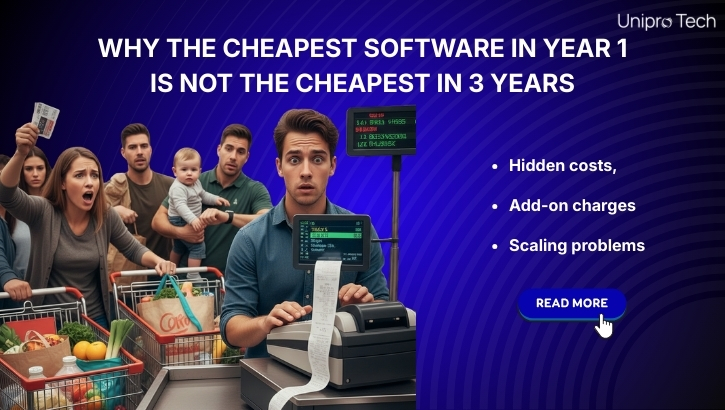
Many business owners select software by looking only at the initial price. If one system is Low-Priced in Year 1, it feels like the smartest decision. But in reality, the Low-Priced software in the beginning often becomes the most expensive mistake over time.
As your business grows, your operations become more complex. You handle more customers, more products, more transactions, and more data. If your software cannot grow with you, it will start to slow you down, create errors, and limit your potential.
Growth requires speed, scalability, automation, and intelligence. A system that cannot support your future will slowly drain your time, money, and energy. Short-term savings can quickly turn into long-term losses.
This blog explains why choosing software only based on price is risky and how to make a smarter decision for your business future.
1. Why Businesses Choose the Low-Priced Option in Year 1
When a business is new, the main focus is on minimizing expenses. Rent, staff salaries, stock, and basic operations demand most of the budget. Software is often viewed as just another cost, not an investment.
Many business owners choose the Low-Priced option because of:
- A limited starting budget
- Pressure to reduce initial costs
- Focus on only basic requirements
- Attractive low price offers
- Lack of long-term planning
- Limited understanding of future scale
In a small and simple setup, basic software seems to work. But that is only because the business itself is still small.
2. How Your Business Changes Over Three Years
A successful business does not stay small. It expands in different ways.
Within three years, businesses usually experience:
- Higher customer footfall
- More transactions every day
- A wider range of products or services
- Larger inventory volumes
- More staff and system users
- Multiple counters or branches
- Increased demand for reports and analytics
- Need for automation and faster operations
The same system that worked in Year 1 starts to struggle in Year 3. Speed slows down, errors increase, and important features are missing.
3. The Hidden Costs and Add On Charges of Low-Priced Software
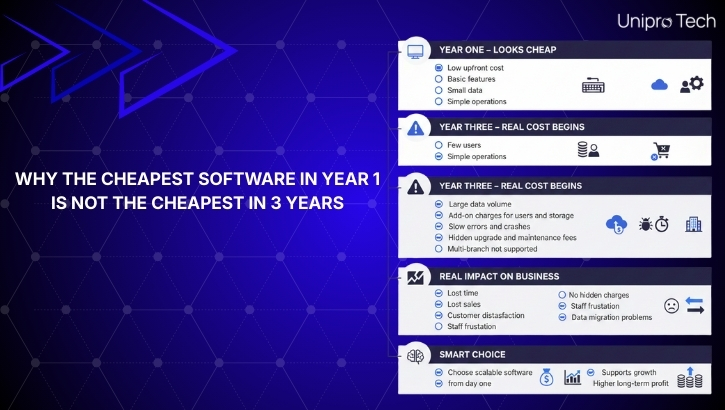
The real cost of software is not the price you pay at the beginning. It is the cost you keep paying over time.
Low-Priced software often looks affordable only because many essential features are locked behind extra charges or limitations.
Hidden costs include:
- Slow performance as data grows
- System crashes and errors
- Limited storage and user access
- Manual work that increases staff dependency
- Inventory mismatches and stock errors
- Slow billing that causes customer frustration
- Lack of detailed reporting for decision making
- Costs involved in switching software later
On top of this, many providers add additional charges that are not clearly mentioned at the start:
- Charges for additional billing counters
- Extra fees for each new user or staff login
- Costs for inventory modules or advanced reports
- Cloud storage limits and extra storage fees
- Charges for multi-branch and warehouse support
- Integration fees for barcode scanners, printers and weighing scales
- Monthly or yearly maintenance and AMC charges
- Fees for upgrades and new software versions
- Extra costs for backup and data recovery
Over three years, these small charges keep adding up. What looked like a Low-Priced solution in Year 1 often becomes more expensive than a complete, scalable system that included everything from the beginning.
The real question should never be
How Low-Priced is this software today?
Instead, it should be
How much will this software really cost me in three years when my business has grown?
Hidden charges not only damage your budget. They also create confusion, mistrust, and long-term dependency on a system that constantly demands more money just to perform basic tasks.
A truly scalable system offers transparent pricing, clear features, and the ability to grow without unpleasant surprises.
4. Low-Priced Software vs Scalable Software
| Factor | Low-Priced Software | Scalable Smart Software |
|---|---|---|
| Initial cost | Low | Moderate |
| Cost after three years | Very high | Controlled |
| Handles business growth | Poor | Excellent |
| Performance over time | Decreases | Stable and fast |
| Inventory accuracy | Weak | Highly accurate |
| Multi-branch support | Not available | Fully supported |
| Reporting and insights | Basic | Advanced and real time |
| Automation | Not available | AI and automated |
| Long term value | Low | Very high |
5. Why Scalability Is Critical for Retail and Service Businesses
Retail stores, supermarkets, restaurants, and service businesses rely on speed and accuracy to stay competitive.
Your software must be able to support:
- High transaction volumes
- Real-time inventory control
- Multiple counters and locations
- Remote monitoring and reporting
- Automation and smart features
- AI-driven forecasting and analysis
If your system cannot handle growth, your business will be limited by technology instead of market demand.
6. How Smart Software Supports Long-Term Growth
A scalable and intelligent system supports your business at every stage of growth.
It provides:
- Fast and smooth billing even at high volumes
- Real-time inventory tracking and control
- Automated purchasing and stock planning
- Detailed analytics and reporting
- Centralised management for multiple locations
- Better coordination between staff and management
- Improved customer experience
- More control over profit and expenses
Instead of creating problems, your software becomes a powerful growth engine.
7. The Real Business Risk Nobody Talks About: Being Locked In or Left Behind
One of the biggest dangers of choosing Low-Priced software is not just financial. It is the risk of being stuck with a system that cannot progress while your competitors move forward.
Many low-cost systems come with serious limitations such as:
- No proper data export options
- Closed systems with no integrations
- Outdated technology
- No regular updates
- Weak customer support
- Poor backup and data security
When your business grows and you realise the system is holding you back, switching becomes risky and expensive. Sales data, customer information, stock records, and reports can be lost during migration. Training staff again and reconfiguring workflows also consumes time and money.
At the same time, competitors who invested in scalable systems are already:
- Opening new outlets
- Using AI-powered insights
- Reducing operating costs
- Improving customer experience
- Expanding into new markets
- Adopting online and omnichannel models
The real cost of Low-Priced software is not just money. It is lost time, lost opportunities, and lost market position.
Choosing the right system is not just a technical decision. It is a strategic decision that shapes your future.
8. Choosing the Right System for the Future
When selecting software for your business, do not ask only one question.
How much does it cost today?
Instead, ask:
- Can this system support me in three year
- Will it handle more data and more customers
- Can it manage multiple locations
- Does it offer automation and intelligence
- Will it reduce my workload
- Does it give clear business insights
A scalable system protects your business from frequent disruptions, costly migrations, and unnecessary stress.
It allows you to focus on growth instead of constantly fixing system problems.
9. Why Low-Priced Software Fails Growing Businesses
Call to Action – With Book Demo
Choose Growth Over Short-Term Savings
Do not let low-cost software limit your business expansion. Upgrade to a scalable POS and inventory solution built for long-term success.
Book a Demo: https://retailpos.co.in
Email: salesenquiry@uniprotech.co.in
Frequently Asked Auestions
Not always, but it is usually designed for very small or temporary use and not for growing businesses.
If you experience slow speed, data errors, reporting issues, or plan to expand, it is time to upgrade.
The initial investment may be higher, but the long-term cost is far lower and more profitable.
It allows your system to grow with your business without needing replacement every few years.
Yes. Many low-cost solutions charge extra for essential features such as additional users, extra branches, more storage, advanced reports, upgrades, and integrations.
Choosing based only on price instead of long-term value and performance.
Why the Low-Priced Software in Year 1 Is Not the Low-Priced in 3 Years Read More »