In retail operations, billing is one of the most critical control points.
Even minor irregularities at the billing counter, when repeated consistently, can lead to significant revenue leakage especially in businesses operating multiple stores and counters.
One such scenario frequently observed in retail environments is under-billing:
Items worth ₹5,000 are billed at ₹4,500,
the full cash amount is collected from the customer,
and the remaining amount never enters the system.
There is no bill cancellation, no refund entry, and no immediate mismatch at the counter.
At a glance, the transaction appears legitimate.
However, when billing systems are connected to ERP-level analytics, such activities leave identifiable data patterns.
With more than two decades of experience working closely with retail businesses, Uniprotech RetailPOS has encountered numerous variations of billing misuse across supermarkets, pharmacies, and large retail chains. This article outlines how ERP integrated POS systems help identify and prevent such frauds.
Billing fraud does not usually occur as a one-time event. Instead, it:
- Happens in small values
- Repeats over long periods
- Blends into daily transactions
In multi-store environments, manual supervision and random audits are rarely sufficient.
This is where centralized ERP visibility becomes essential.
Over time, certain billing misuse patterns appear repeatedly across retail formats. Understanding these helps retailers apply the right controls.
In this case:
- Only a portion of items are billed
- The customer pays the full amount in cash
- The system records a lower bill value
Because no cancellation or refund is involved, detection requires behavioral and pattern-based analysis rather than transaction-level checks.
Here:
- A bill is created and payment is collected
- The bill is later voided or deleted
- Cash does not get accounted for in the system
ERP systems track cancellation frequency, timing, and user activity to identify anomalies.
Fraudulent refund entries may be created:
- Without actual product returns
- Using old or unrelated transactions
Such actions are often revealed through unusual refund patterns tied to specific users or shifts.
Repeated manual discounts, especially without approval, can:
- Reduce margins quietly
- Go unnoticed in daily summaries
ERP reports highlight discount trends by cashier, store, and time period.
When inventory depletion does not match billed sales, it can indicate:
- Unbilled movement
- Partial billing
- Process misuse
ERP-level correlation between stock and billing helps surface these inconsistencies.
In chain retail, similar billing behaviors may surface across:
- Different outlets
- Different cashiers
- Extended periods
ERP systems identify these patterns through cross-store comparisons, enabling early intervention.
Billing and payment fraud in retail is evolving rapidly.
As businesses adopt digital payments, ERP systems, and centralized billing, fraud patterns are also becoming more sophisticated.
Today, fraud is not limited to external threats. In many cases, it originates within the store, often exploiting gaps in processes, permissions, or visibility.
Below are some of the key billing and payment fraud trends retailers should be aware of.
Recent industry studies indicate that a significant number of fraud incidents originate internally. Trusted staff may misuse their access by:
- Cancelling bills after collecting payment
- Creating fake refunds or returns
- Applying unauthorized discounts during unattended hours
These activities often go unnoticed when controls rely only on end-of-day checks.
How Retail POS Helps:
ERP-integrated Retail POS systems use:
- Role-based access controls
- User-level activity logs
- Real-time monitoring of cancellations, refunds, and discounts
This helps detect internal misuse early, before losses accumulate.
With the rise of UPI, wallets, and QR-based payments, new fraud risks have emerged at billing counters, including:
- Fake or replaced QR codes
- Misuse of “collect request” features
- Payments diverted to personal UPI IDs instead of official business accounts
Such issues are harder to trace if billing and payment systems operate separately.
How Retail POS Helps:
Retail POS systems integrated with secure payment gateways ensure:
- Payments are linked directly to billing transactions
- Only authorized QR codes and payment IDs are used
- Reduced dependency on manual verification by staff
Gift cards and vouchers introduce another layer of risk when not properly tracked. Common misuse scenarios include:
- Issuing gift cards without recording them in the system
- Redeeming vouchers fraudulently
- Manipulating balances or expiry details
Without system-level controls, these frauds can remain invisible for long periods.
How Retail POS Helps:
ERP-based billing systems track:
- Gift card issuance and redemption
- Balances and expiry dates
- Approval workflows for high-value vouchers
This ensures accountability and audit readiness.
Many small and mid-sized retail businesses still rely on:
- End-of-day reports
- Weekly or monthly reviews
By the time discrepancies are noticed, identifying the root cause becomes difficult.
How Retail POS Helps:
Real-time dashboards and alerts enable retailers to:
- Monitor billing activity as it happens
- Get instant alerts for unusual cancellations, refunds, or discounts
- Act quickly before issues escalate
Protecting your billing system does not require complex IT infrastructure or expensive security tools.
Even small and mid-sized retail businesses can significantly reduce billing misuse by applying a few well-defined controls supported by the right technology.
A secure billing system is one that is transparent, traceable, and monitored continuously. Below are practical steps retailers can take to strengthen billing security and reduce revenue leakage.
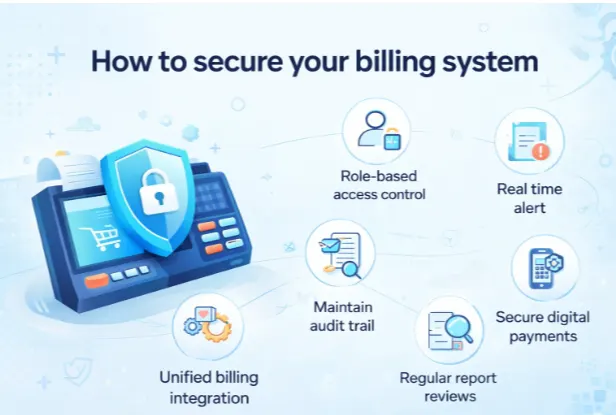
One of the biggest risks in billing systems is unrestricted access.
When multiple employees share logins or have full system permissions, it becomes difficult to track responsibility and misuse becomes easy.
A safer approach is to define role-based access where permissions are assigned strictly based on job responsibility.
Typical role separation:
- Cashier: Create bills and accept payments
- Supervisor: Approve discounts, returns, or corrections
- Owner/Admin: Access reports, logs, and configuration settings
This ensures employees can perform only the actions relevant to their role.
Why this matters:
If bill cancellations or refunds require supervisor approval, every exception has a clear authorization trail—discouraging misuse and improving accountability.
Reviewing reports days later often means the problem has already grown.
Real-time monitoring allows you to act while the activity is happening.
A secure billing system should flag unusual actions such as:
- Frequent bill cancellations
- High-value refunds
- Discounts beyond permitted limits
- Price edits or negative sales entries
Example:
If multiple bills are cancelled within a short period, the system can notify you immediately. Even if you are not physically present at the store, you can review the activity remotely and take action.
Real-time visibility creates awareness among staff that billing actions are continuously monitored.
Every secure billing system needs a detailed audit trail a permanent record of all activity.
This includes:
- Who performed the action
- What was changed
- When it was done
- From which terminal or user account
Audit trails help businesses:
- Investigate discrepancies quickly
- Identify responsibility without assumptions
- Maintain compliance and internal discipline
Example:
If a refund is processed without the item being physically returned, the audit log shows exactly who approved it and when making follow-up straightforward and factual.
Disconnected systems create blind spots.
When billing, inventory, and accounts operate independently, inconsistencies are harder to detect and easier to exploit.
By integrating billing with inventory and accounting:
- Stock levels update automatically with every sale
- Accounts reflect transactions in real time
- Any deletion or adjustment creates visible mismatches
Example:
If a bill is removed after a sale, inventory movement no longer aligns with sales data triggering a red flag that requires review.
Integration closes loopholes that manual checks often miss.
Fraud rarely appears as a single large incident.
It usually emerges as repeated small actions that follow a pattern.
Key reports to review regularly:
- Discount reports: Identify repeated or unusually high discounts
- Refund and return logs: Detect excessive or irregular refund activity
- Void bill reports: Track frequency and reasons for cancellations
Example:
If refunds are consistently issued by the same user during late shifts, it warrants closer attention.
Regular review sends a clear message: every billing action is visible and accountable.
Digital payments have simplified billing but also introduced new risks if not managed properly.
Common risks include:
- Replacement of official QR codes with personal ones
- Misuse of “collect request” features
- Payments diverted to personal UPI IDs
To reduce these risks:
- Use verified, official business QR codes only
- Integrate digital payments directly with the billing system
- Reconcile digital transactions daily against billing records
This ensures payments cannot bypass the system.
Technology alone is not enough.
Many billing issues arise due to lack of awareness rather than malicious intent.
Regular training helps employees:
- Follow standard billing procedures
- Avoid password sharing
- Verify payments before confirming sales
- Report suspicious behavior early
When staff understand why controls exist, they are more likely to follow them—and less likely to misuse them.
Uniprotech RetailPOS is designed with built-in controls that help retailers prevent billing misuse without disrupting daily operations.
Key security capabilities include:
- Role-based permissions for every user
- Real-time alerts for cancellations, refunds, and discounts
- Integrated billing, inventory, and accounting
- Approval workflows for sensitive actions
- Session-level tracking and shift handover controls
- Cash and digital payment reconciliation
- Complete audit logs with secure backups
- Optional integrations such as weighing scales for accurate billing
These features work together to create a billing environment where every transaction is traceable and every exception is visible.
Modern POS systems log every cashier interaction, including:
- Item scans
- Bill edits
- Time spent per transaction
- Finalization behavior
ERP analytics evaluate these logs to detect deviations from normal billing patterns.
Beyond simple cash tallies, ERP systems analyze:
- Average bill values
- Cash vs digital payment ratios
- Shift-wise performance
Consistent deviations from store or chain averages become visible over time.
Instead of fixed rules, ERP systems compare:
- Cashier performance against peers
- Counter behavior within the same store
- Trends across similar outlets
This approach highlights anomalies without alerting the cashier.
By reviewing inventory movement alongside sales data, ERP systems can identify gaps that may indicate under-billing or misuse.
Even when irregularities are detected later, ERP logs allow businesses to:
- Review historical activity
- Reconstruct billing behavior
- Base decisions on data rather than assumptions
Manual checks rely heavily on observation and intuition.
ERP-based systems rely on data consistency, trend analysis, and centralized visibility.
For multi-chain retail operations, this approach enables:
- Early detection
- Reduced revenue leakage
- Scalable control across locations
Billing misuse often begins with small actions—an unapproved discount, a cancelled bill, or a missing entry.
Left unchecked, these actions quietly erode profits and trust.
The most effective protection comes from clear controls, continuous visibility, and systems that operate consistently without fatigue or bias.
With a secure, ERP-integrated Retail POS system, businesses can move from reactive checks to proactive control ensuring that every transaction is accounted for and every rupee is protected.


Billing fraud in retail is any manipulation of the billing or payment process that results in incorrect sales records or revenue loss. This includes under-billing, fake refunds, unauthorized discounts, and bill cancellations after payment collection.
Billing fraud typically occurs through internal misuse such as partial billing, refund manipulation, excessive discounts, or diverting digital payments. These actions often exploit weak controls, shared logins, or lack of monitoring.
Yes. Under-billing fraud can occur without bill cancellation when only part of the items are billed while full payment is collected. This type of fraud is detected through pattern analysis, not single transactions.
No. End-of-day settlement only checks cash balance and does not reveal how transactions were processed. Real-time monitoring and activity logs are required to detect billing misuse early.
Role-based access restricts system actions based on job roles. It ensures that cashiers, supervisors, and admins can only perform authorized actions, improving accountability and reducing misuse.
An audit trail is a complete record of all billing activities, including edits, refunds, cancellations, and approvals. It logs who performed each action, when it occurred, and what was changed.
ERP integration connects billing, inventory, and accounting systems. This ensures all transactions are automatically synchronized, making mismatches and fraudulent activity easier to detect.
Digital payments reduce cash handling risks but introduce new fraud types such as QR code misuse or payment diversion. The safest approach is to integrate digital payments directly with the POS system and reconcile them daily.