
Menu
Your Supermarket's Fresh Produce Section Is Losing More Money Than You Think and GST Exemption Is Part of the Problem
A guide for supermarket and grocery chain owners managing fresh produce, dairy, and perishables across India
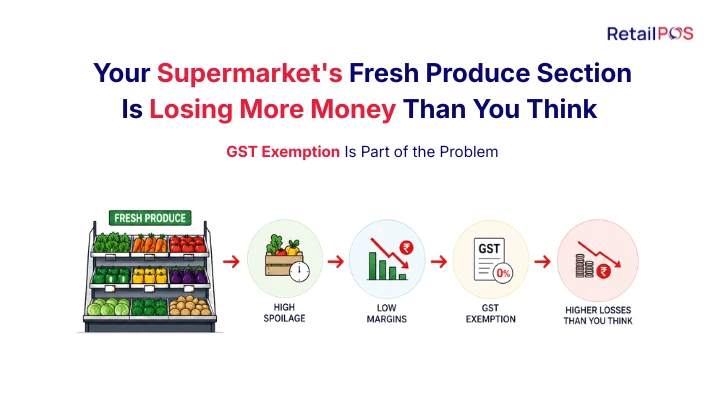
Section 1: The Wastage Problem Hiding in Plain Sight in Your Produce Section
India wastes an estimated 78 to 80 million tonnes of food every year, a loss valued at roughly Rs 1.55 lakh crore, even as a large share of the population remains undernourished. Most of this conversation in India focuses on the farm gate, on cold storage infrastructure, and on the journey from harvest to market. What gets far less attention is the wastage that happens after the produce has already arrived at your supermarket, sitting in your crates, on your shelves, and in your back-of-store cold storage right now.
For a supermarket or grocery chain owner in India, this is not an abstract national statistic. It is a direct line item in your own profit and loss account, and in most Indian supermarkets, it is a line item that nobody is actually measuring with any precision. Ask a supermarket chain owner what percentage of their fresh produce section is written off every week and you will almost always get a shrug, a rough guess, or silence. The produce that goes soft, the tomatoes that bruise in transit, the leafy greens that wilt before the evening rush, the dairy that crosses its date code on a slow Tuesday, all of it disappears from the shelf and from the conversation at the same time.
This guide is specifically about that gap: the produce and perishables wastage that every Indian supermarket experiences, the structural reasons it stays invisible, the specific GST-related blind spot that makes it worse, and what a properly configured inventory system does to bring this loss into the light where it can actually be managed.
Section 2: Why Fresh Produce Wastage Is Structurally Invisible in Most Indian Supermarkets
Dry grocery and packaged FMCG items have a built-in accountability mechanism: every unit has a barcode, every unit has a fixed shelf life measured in months or years, and every unit that disappears without a sale is relatively easy to trace back to a cause.
Fresh produce has none of these built-in protections. A kilo of tomatoes does not arrive with a barcode on each tomato. Its useful shelf life is measured in days, not months, and varies depending on handling, temperature, and even the specific batch from the same supplier. When a crate of spinach wilts on a Thursday afternoon, there is rarely a system record created at all. A floor staff member simply removes it from display and disposes of it, often without weighing it, without recording its value, and without anyone at head office ever finding out it happened.
This is the core structural reason fresh produce wastage stays invisible even in supermarket chains that have reasonably good systems for everything else. The category that is most perishable, most variable, and most prone to loss is also the category least likely to have a formal, recorded write-off process. Multiply this across a chain with five, ten, or fifteen outlets, each with its own produce section, and the chain owner has no consolidated picture of how much fresh produce value is disappearing every single week.
Section 3: The GST Exemption Blind Spot Nobody Talks About
Here is a detail specific to the Indian context that makes this problem worse than it needs to be. Fresh fruits and vegetables are exempt from GST entirely, and unflavoured, unbranded milk is also GST exempt, with the exemption applying broadly to loose, non-packaged staples as well.
This GST exemption was designed to keep essential food affordable for consumers, and it serves that purpose well. But it has an unintended operational side effect inside supermarkets: because these items generate no GST output and require no HSN-coded invoice line in the same way that branded, packaged goods do, fresh produce frequently receives less rigorous tracking in the billing and inventory system than products that have a tax obligation attached to them.
In practice, this means that many supermarket POS configurations in India treat fresh produce as a lower-priority category for detailed inventory tracking, precisely because there is no compliance pressure forcing the issue the way there is for GST-applicable packaged goods. The result is a category that is simultaneously the most prone to wastage and the least rigorously tracked, a combination that almost guarantees the loss stays hidden.
This is not an argument against the GST exemption itself, which remains the right policy for consumer affordability. It is a flag for supermarket operators that the absence of a tax compliance forcing function on this category means the discipline of tracking it accurately has to come from the retailer’s own systems, not from any external pressure.
Section 4: The Five Specific Ways Supermarkets Lose Money on Perishables
4.1 Over-Ordering Without Demand-Based Forecasting
Produce buying in most Indian supermarkets is still done largely on instinct and habit, ordering roughly what was ordered last week, adjusted slightly for an upcoming festival or weekend. Without a system that tracks actual sell-through by SKU and by outlet, over-ordering is the default, because under-ordering creates a visible empty shelf while over-ordering creates an invisible loss that nobody connects back to the original purchase decision.
4.2 No FEFO Discipline at the Shelf Level
First Expiry First Out is well understood in principle but inconsistently applied in practice for fresh produce specifically, because unlike packaged goods, fresh produce rarely has a printed expiry date that staff can check at a glance. Without a system-driven rotation discipline, newer stock often gets placed in front of older stock simply because it is easier to access, accelerating the rate at which the older batch becomes unsellable.
4.3 Informal Write-Offs With No Category-Level Data
When spoiled produce is removed from the shelf and disposed of without being weighed, recorded, or categorised in the system, the supermarket loses the data that would otherwise reveal patterns, specific suppliers whose batches spoil faster, specific SKUs that are consistently over-ordered, and specific outlets where wastage is running higher than the chain average.
4.4 Inconsistent Cold Chain and Storage Handling Across Outlets
A chain with outlets across different parts of a city, or across multiple cities, often has inconsistent refrigeration equipment quality, inconsistent staff training on produce handling, and inconsistent storage practices between locations. Without outlet-level wastage tracking, the chain has no way to identify which specific outlet has a handling or equipment problem that is driving its wastage rate above the others.
4.5 No Markdown Strategy Before Spoilage
Many Indian supermarkets have no systematic process for marking down produce that is approaching the end of its useful shelf life while it can still be sold at a discount, rather than waiting until it has spoiled completely and must be discarded for zero recovery. This is a pure recovery opportunity being missed, not because the produce was unsellable, but because there was no trigger in the system to flag it for markdown while it still had value.
Section 5: The Real Rupee Cost for a Multi-Outlet Supermarket Chain
Industry research on perishable supply chains in India has documented wastage rates for specific produce categories that are strikingly high even before the product reaches the retail shelf, with wastage of certain vegetables like tomatoes recorded at over 12% even in earlier supply chain studies, and broader estimates suggesting that roughly a third of agricultural produce in India is lost across the supply chain. The retail-level wastage that happens inside the store, after the produce has already been purchased and paid for by the supermarket, sits on top of these upstream losses.
Supermarket Profile | Weekly Produce Purchase Value | Wastage Rate at Retail Level | Weekly Loss | Annual Loss |
Single outlet, mid-size | Rs 2 lakh | 8% | Rs 16,000 | Rs 8.3 lakh |
Single outlet, mid-size | Rs 2 lakh | 15% | Rs 30,000 | Rs 15.6 lakh |
5-outlet chain | Rs 10 lakh | 8% | Rs 80,000 | Rs 41.6 lakh |
5-outlet chain | Rs 10 lakh | 15% | Rs 1.5 lakh | Rs 78 lakh |
10-outlet chain | Rs 20 lakh | 10% | Rs 2 lakh | Rs 1.04 crore |
These figures are conservative and specific to the produce and dairy category alone. They do not include the wider category of perishable wastage across the whole store, but they illustrate clearly that even a moderate improvement in produce wastage rates, from say 12% down to 6%, represents a direct and substantial recovery to the bottom line of any multi-outlet Indian supermarket chain, achieved without spending a single additional rupee on marketing or expansion.
Section 6: The Problem vs Solution Breakdown
Wastage Cause | Why It Happens | Technology Solution |
Over-ordering without forecasting | Buying based on habit rather than actual sell-through data | Consumption-based purchase recommendations using historical sales by SKU and outlet |
No FEFO discipline at the shelf | No system-driven batch rotation for unpackaged perishables | Batch and receipt-date tracking that flags older stock for priority sale or markdown |
Informal write-offs with no data | Spoiled produce discarded without being weighed or recorded | Structured wastage recording module with category and reason codes |
Inconsistent handling across outlets | No outlet-level visibility into wastage patterns | Centralised wastage reporting comparing every outlet against the chain average |
No markdown trigger before spoilage | No system alert as produce approaches end of shelf life | Configurable near-expiry alerts triggering markdown pricing while recovery is still possible |
GST exemption reducing tracking rigour | No compliance pressure forcing detailed inventory discipline on this category | Inventory tracking applied consistently across all categories regardless of GST status |
Section 7: Building a Perishable Loss Detection System Inside Your Supermarket Chain
Step 1: Treat fresh produce with the same inventory rigour as GST-applicable goods. The absence of a tax compliance requirement on this category should not translate into less tracking discipline. Weigh, record, and log every unit of produce that enters and leaves your store, sale or write-off, with the same consistency you apply to packaged goods.
Step 2: Record every write-off through the system, never informally. Every spoiled or discarded item must be weighed and logged with a reason code before disposal. This single discipline change converts invisible loss into measurable, manageable data within weeks.
Step 3: Build outlet-level wastage benchmarks. Once wastage is being recorded consistently, compare wastage rates across outlets. An outlet running consistently above the chain average has a specific, addressable handling, ordering, or equipment issue worth investigating directly.
Step 4: Introduce markdown triggers before spoilage, not after. Configure alerts for produce categories approaching the end of their typical shelf life so staff can apply a discount and recover partial value while the product is still sellable, rather than discarding it for a complete loss.
Step 5: Feed wastage data back into purchasing decisions. The categories and SKUs generating the highest wastage should directly inform the next purchase order, reducing the over-ordering that created the loss in the first place.
Section 8: How RetailPOS Helps Supermarket Chains Cut Perishable Wastage
RetailPOS by Unipro Tech Solutions provides supermarket and grocery chains with the specific inventory infrastructure to bring fresh produce and perishable wastage out of the shadows and into a managed, trackable process.
Weighing scale integration for loose and fresh items. Every fresh produce sale is captured directly from the weighing scale into the billing and inventory system, ensuring accurate stock deduction even for unpackaged, unbarcoded goods that have historically been the hardest category to track.
Batch and expiry tracking extended to perishables. RetailPOS applies the same batch and date-based tracking discipline used for packaged dairy and FMCG goods to fresh produce categories, enabling FEFO-based shelf rotation and giving staff a system-driven prompt rather than relying on visual inspection alone.
Structured wastage recording with reason codes. Spoiled and discarded produce is logged through a dedicated module with category and reason codes, replacing informal disposal with a permanent, searchable record of what was lost, where, and why.
Outlet-level wastage reporting on the Cockpit dashboard. A supermarket chain owner managing multiple outlets can see wastage rates by location and by category in real time, identifying which specific outlet needs attention long before it shows up as an unexplained margin gap in the monthly accounts.
Near-expiry alerts for markdown decisions. Configurable alerts flag perishable stock approaching the end of its useful shelf life, giving the store manager the opportunity to apply a markdown and recover partial revenue rather than discarding the product for zero return.
Consumption-based purchase recommendations. Historical sales data by SKU and by outlet informs smarter produce ordering, directly reducing the over-ordering that is one of the most common root causes of fresh produce wastage in Indian supermarkets.
Conclusion: The Most Perishable Category in Your Store Deserves the Most Rigorous Tracking, Not the Least
India’s food wastage problem is enormous at a national scale, and every supermarket and grocery chain in the country is, in a small but very real way, contributing to it inside their own stores every single week. The irony is that fresh produce, the category most prone to loss, is often the category receiving the least systematic inventory attention, partly because it lacks barcodes, partly because it lacks a fixed shelf life, and partly because its GST-exempt status removes the compliance pressure that keeps other categories under tighter control.
None of these are good reasons to let this category remain a blind spot. A supermarket chain that brings the same weighing, batching, and wastage-recording discipline to its produce section that it already applies to packaged goods will find a measurable, recoverable margin sitting in a category that everyone assumed was simply a cost of doing business.


Book a free demo and see how RetailPOS helps your supermarket chain bring fresh produce and perishable wastage under control.
Frequently Asked Questions
Fresh fruits, vegetables, and unbranded milk are exempt from GST in India. Because these items do not generate tax output or require the same HSN-coded invoicing discipline as taxable goods, many supermarket systems end up applying less rigorous inventory tracking to this category. The tracking discipline that GST compliance indirectly enforces on packaged goods simply has to come from the retailer's own internal systems for produce, since there is no external compliance pressure forcing the issue.
Weighing scale integration linked to the billing and inventory system allows produce sold by weight to be deducted from stock accurately at the point of sale, even without a barcode on each unit. The same integration supports recording write-offs by weight when produce is discarded, giving the supermarket an accurate rupee value for wastage by category, even for completely unpackaged goods.
Wastage rates for fresh produce vary by category and by season, but supermarkets with strong demand forecasting, FEFO discipline, and proactive markdown processes can typically bring wastage down to the 5 to 8% range, compared to the 12 to 20% or higher range commonly seen in stores without these systems in place.
The weighing and logging step adds only a few seconds per write-off when integrated directly into the POS system, since the scale captures the weight automatically and the staff member only needs to select a reason code. This is a small operational addition compared to the financial visibility it creates, and most supermarkets find staff adapt to the habit within the first week.
Yes. The Cockpit dashboard provides outlet-level wastage reporting by category, allowing a chain owner to identify which specific outlets are running above the chain average and investigate the specific handling, equipment, or ordering issue driving that outlet's higher loss.
About RetailPOS
RetailPOS is an enterprise retail POS and ERP solution by Unipro Tech Solutions Pvt Ltd, headquartered in Chennai, Tamil Nadu. With over 20 years of experience and 10,000 plus businesses served across India and globally, RetailPOS provides purpose-built technology for supermarket chains, grocery retailers, apparel chains, electronics retailers, and multi-format retail groups. Products include RetailPOS Enterprise, WeighSense AI, Cockpit multi-outlet dashboard, and Analytics.