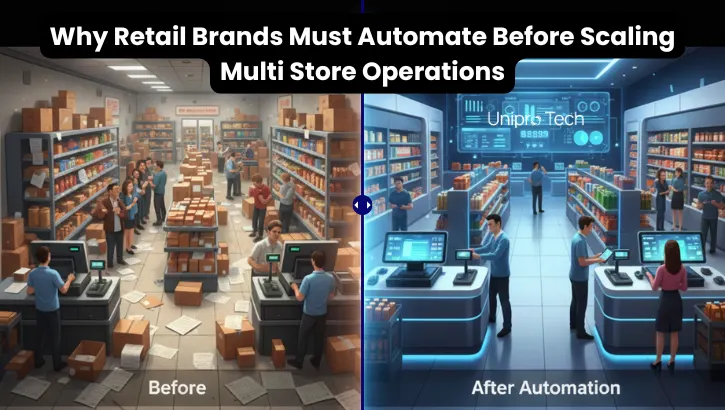
Scaling a retail business from 2 stores to 5 stores or from 5 stores to 20 becomes extremely difficult without centralized retail management. As store networks grow, manual work and human dependency multiply. This is why medium scale retailers must adopt end to end retail automation and modern retail software before expanding further.
Retailers who automate early scale faster, reduce operational leakage, and maintain consistent processes across every outlet.
2. Why Scaling Without Automation Fails
Most medium scale retailers begin with manual or semi digital workflows. These may work for 1 or 2 stores, but they collapse when the retail network expands.
Without automation, retailers face:
- No real time visibility
- Delayed sales reporting
- Manual inventory updates
- Inconsistent pricing and promotions
- High shrinkage
- Wrong procurement decisions
- Slow billing and long queues
- Heavy dependency on store staff
This slows down growth and makes scaling extremely risky.
Automation through a retail ERP, supermarket POS system, or cloud based retail software solves these challenges immediately.
3. What Retail Automation Provides to Growing Retailers
With automation, retail brands gain the essential tools required for expansion.
3.1 Unified Dashboards
A centralized multi store retail dashboard provides complete visibility into:
- Live sales
- Store wise performance
- Real time stock
- Purchase and GRN data
- Category and brand insights
Retailers no longer wait for manual WhatsApp updates or daily reports.
3.2 Standardized Processes Across All Stores
Automation ensures every outlet follows the same workflow for:
- Billing
- Inventory operations
- GRN
- Stock audits
- Shelf refill
- Purchase cycles
- Promotions and discounts
This delivers consistent customer experience and eliminates confusion across branches.
3.3 Centralized Pricing and Promotions
A modern supermarket POS software allows retailers to manage:
- Price updates for all stores
- Promotions and offers
- Product catalogs
- Digital price sync across locations
No more mismatched shelf labels or manual price changes.
3.4 Store to Store Transfer Visibility
Through automated inventory management, retailers gain complete control over:
- What was transferred
- What was received
- Missing or damaged items
- Approval workflows
- Internal stock shrinkage
This reduces leakage between stores and improves overall accuracy.
4. Retailers Believe Automation Is Expensive But Losses Are Higher
Many medium scale retailers assume automation costs more.
In reality, the hidden losses cost much more than any software investment.
What is more expensive than automation:
- Wastage
- Stock losses
- Expired items
- Over staffing
- Inefficient processes
- Slow billing during peak hours
- Wrong purchasing
- Manual entry errors
- A strong retail automation system reduces costs across every department.
5. Automation Reduces Operational Leakage and Shrinkage
Shrinkage through spoilage, theft, miscounts, barcode errors, or human mistakes quietly eats 2 to 6 percent of revenue in most supermarkets and grocery stores.
As a store network expands, shrinkage grows even faster.
End to end retail automation reduces shrinkage through:
- Batch and expiry tracking
- Accurate inventory sync
- Digital GRN
- Controlled access
- Automated store transfers
- Stock variance reports
- Real time alerts
Retailers who automate early reduce shrinkage significantly.
6. Growing Store Networks Create Rapid Complexity
The bigger the supermarket network, the more complex operations become.
A retailer with:
- 2 stores is manageable
- 5 stores becomes challenging
- 10 stores becomes unstable
- 20 stores becomes chaotic without automation
Every new branch increases workload in:
- Inventory control
- Purchasing cycles
- Billing and checkout
- Refill and replenishment
- Reporting
- HR and training
- Promotions
- Delivery operations
This is why scaling requires an end to end retail ERP system or a cloud based supermarket management solution.
7. Automation Replaces Repetitive Manual Tasks With Accurate Workflows
Medium scale retailers lose hours daily on repetitive tasks like:
- Stock inward
- Manual expiry checks
- Manual purchase orders
- Transfer documentation
- Sales reporting
- Physical audits
Automation replaces all of these with:
- Automatic stock updates
- Automatic expiry alerts
- Automatic purchase suggestions
- Automatic GRN matching
- Automatic daily sales summaries
- Automatic inventory variance reports
This allows staff to focus on customer service instead of paperwork.
It also improves:
- Checkout speed
- Store appearance
- Customer satisfaction
- Upselling and cross selling
8. Why Retailers Must Automate Before Expanding
If a retailer expands without automation, every new store adds:
- More manual work
- More shrinkage
- More errors
- More dependency on staff
- More complexity
- Less visibility
Retailers who automate before scaling achieve:
- Faster growth
- Higher store performance
- Better margins
- Lower wastage
- Accurate inventory
- Better customer experience
- Stronger control
- Smooth multi store expansion
Automation is the foundation of retail growth.
9.Final Takeaway
Medium scale retailers with 2 to 10 stores who adopt end to end retail automation grow faster, improve customer experience, control inventory better, and scale confidently.
Automation provides:
- Centralized control
- Standardized operations
- Real time stock visibility
- Faster billing
- Smarter purchasing
- Lower wastage
- Higher efficiency
If you are planning to expand from 2 to 5 stores or from 5 to 20 stores, automation should be your first investment.
Want to Automate Your Retail Chain Before Scaling?
Book a free demo of RetailPOS to see how multi-store automation can help you grow efficiently and profitably.
Email: salesenquiry@uniprotech.co.in
Phone: +91 44-421 421 40
Website: retailpos.co.in
Frequently Asked Auestions
Automation is essential for medium scale retailers because it centralizes control, reduces manual work, improves inventory accuracy, prevents shrinkage, and standardizes processes across all stores. Without automation, scaling from 2 to 5 or 5 to 20 stores becomes inefficient and costly.
Retail automation provides real time dashboards, unified inventory control, centralized pricing, automated purchasing, and accurate store to store transfer tracking. These features remove operational complexity, making it easier to expand into new locations without losing control.
Retailers often face stock mismatches, slow billing, inconsistent pricing, heavy staff dependency, wrong purchasing decisions, shrinkage, wastage, and lack of visibility. These issues multiply as store count increases, making manual operations unsustainable.
Automation is not as expensive as most retailers think. In fact, the real cost comes from shrinkage, wastage, inefficiency, overstaffing, and billing errors. Automation reduces these losses and delivers long term savings that outweigh the software investment.
Automation reduces shrinkage by implementing batch and expiry tracking, digital GRN, restricted user access, real time inventory updates, automated stock transfers, and variance reports. These controls eliminate the manual errors and internal leakages that normally cause 2 to 6 percent revenue loss.
Retailers should look for real time inventory management, automated purchasing, multi store dashboards, centralized pricing, mobile apps for staff, stock audit tools, delivery integration, and a complete retail POS and ERP solution that supports chain wide operations.