
Work in Progress Tracking Solution for Indian Manufacturers: Complete 2026 Guide
A complete guide for Indian manufacturers, production managers, and operations directors evaluating work in progress tracking solutions
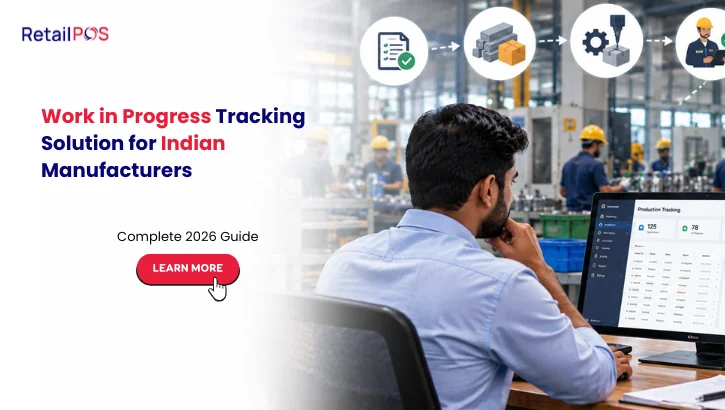
The Manufacturing Moment India Is In Right Now
Today, September 23, 2026, India’s HSBC Flash Manufacturing PMI rose to 55.7, its strongest reading in seven months, driven by accelerating output growth and a surge in new orders. India’s private sector is expanding at the fastest pace since June and manufacturing is leading that expansion.
For Indian manufacturers, this is the environment they have been building toward. Orders are arriving faster. Production volumes are increasing. Capacity is being stretched. New production lines are starting up. The Make in India and PLI scheme investment cycles that began earlier this decade are translating into real output growth right now.
This growth is genuinely exciting. It also creates a specific operational challenge that every manufacturer encounters at scale: the challenge of knowing, at any moment, exactly where every order is in the production process.
When a factory is producing 50 units per day, the production manager can walk the floor and know instinctively what is in progress, what is waiting, and what is ready to ship. When that same factory is producing 500 units per day across multiple product lines, multiple shifts, and multiple production stages, the floor walk no longer works. The information that used to exist in one person’s observation now needs to exist in a system.
This is what a work in progress tracking solution provides. Not management complexity. Management visibility. The real-time data about where every production order is, what stage it is at, and when it will be ready that allows a manufacturing business to scale its output without losing the operational clarity that made it good at what it does.
Section 1: What Work in Progress Actually Is and Why It Becomes Invisible at Scale
Work in progress, commonly abbreviated as WIP, refers to all production orders and partially completed units that are currently somewhere in the manufacturing process. At any given moment, a manufacturing facility’s WIP includes everything that has left raw material storage but has not yet become finished goods ready for delivery.
For a small manufacturing operation, WIP management is intuitive. The production manager can see what is on the floor. They know what stage each order is at because they can observe it directly. The question “where is Order 247?” has an immediate answer because the facility is small enough that the answer is visible.
Scale changes this. When the number of concurrent production orders grows, when the production process has multiple stages with handoffs between them, when production runs across multiple shifts where each shift’s output becomes the next shift’s input, the intuitive visibility that worked at small scale breaks down completely.
The production manager can no longer see all the work in progress simultaneously. They have to ask. The answer depends on who they ask, how recently that person checked, and whether the information communicated matches what is actually on the floor. WIP becomes invisible not because it disappears but because the information about it is distributed across multiple people’s memories rather than captured in a single real-time system.
Section 2: The Five Operational Problems That Appear When WIP Becomes Invisible
2.1 Customer Delivery Date Commitments Made Without Reliable Data
When a sales team commits to a customer delivery date, that commitment should be based on the current production workload, the capacity available for the new order, and the realistic completion timeline for orders already in progress. When WIP is invisible, this commitment is based on the production manager’s estimate, which is based on their impression of the floor status, which may be hours or days out of date.
The result is delivery date promises that are unreliable. Some orders are delivered ahead of the promised date when the production team overestimated workload. More damaging, some orders are delayed because the production team underestimated how much was actually in progress ahead of the new order. Customer relationships are damaged by commitments that the company cannot keep because the information needed to make reliable commitments does not exist in real time.
2.2 Bottleneck Stages That Are Discovered Late
Every production process has stages that are slower than others. A bottleneck is the stage where work accumulates because the throughput capacity is lower than the demand being placed on it. In a well-managed production facility, bottlenecks are known, measured, and actively managed. In a facility where WIP is invisible, bottlenecks are discovered when the pile of work waiting at a specific stage becomes physically obvious.
By the time a bottleneck becomes physically obvious, it has already delayed a significant volume of production. The orders waiting behind the bottleneck are already behind schedule. The upstream stages that fed work to the bottleneck have either continued producing, making the backlog larger, or have been idle while waiting for the bottleneck to clear, wasting capacity.
2.3 Quality Issues Identified at the End Rather Than at the Stage
Quality management in production is most effective when quality checks happen at each stage of the production process rather than only at the final inspection. A defect identified at Stage 3 of a 7-stage process requires rework of only the Stage 3 work. A defect that reaches final inspection as a Stage 3 error has had 4 additional stages of production added to a unit that may ultimately be scrapped or require extensive rework.
When WIP is invisible, the quality data from each stage is also invisible. Quality managers see the output of the full production process at final inspection rather than the output of each stage as it is completed. Problems that could have been caught and corrected at Stage 3 are found at Stage 7, with all the additional cost that represents.
2.4 Raw Material Consumption That Cannot Be Reconciled
Manufacturing businesses maintain raw material inventory and track consumption against production output. When WIP is visible in a real-time system, raw material consumption can be reconciled against production output at any stage: how much of each material entered the production process, where it is currently in that process, and how much has been incorporated into completed output.
When WIP is invisible, raw material reconciliation can only happen against finished goods. The material that went into production and has not yet become finished goods is a gap in the accounting that grows with every production order that is in progress simultaneously. For auditing, for cost tracking, and for identifying material losses that occur within the production process rather than in storage, this gap is a significant problem.
2.5 No Basis for Production Scheduling Decisions
Production scheduling, the assignment of new orders to specific production slots, machines, and shifts, requires knowing the current status of all existing production orders. A scheduler who does not know which orders are at which stage, how far each is from completion, and which machines and operators are currently occupied cannot make reliable scheduling decisions.
Without this information, scheduling defaults to first-in-first-out with generous buffers to account for uncertainty. These buffers represent planned idle time that reduces production throughput and increases lead times beyond what the actual production process requires.
Section 3: What a Work in Progress Tracking Solution Does
A work in progress tracking solution is software that maintains a real-time record of every production order’s status at every stage of the manufacturing process. It tells management, at any moment, exactly where every order is in the production flow, how long it has been at the current stage, when it is expected to complete, and whether anything in the current production status creates a risk to committed delivery dates.
At the most basic level, a WIP tracking solution:
- Creates a production order record for every job entering the manufacturing process
- Records the movement of each order from stage to stage as production progresses
- Shows the current status of every in-progress order on a live dashboard
- Alerts management when any order is taking longer than expected at any stage
At an advanced level, a WIP tracking solution additionally:
- Integrates with raw material inventory to track material consumption per production order
- Links to quality management records capturing the result of each stage inspection
- Connects to machine and operator scheduling for resource allocation visibility
- Provides production analytics showing throughput rates, bottleneck patterns, and quality performance by stage
- Feeds data to the sales and dispatch team for reliable delivery date commitment
Section 4: How WIP Tracking Works: The Complete Production Flow
Stage | Physical Event | WIP System Action |
Order creation | Sales order or production planning generates a new production job | Production order created in system with specifications, quantity, and committed delivery date |
Raw material issue | Materials released from stores to production floor | Material issuance recorded against the production order, inventory updated |
Stage 1 entry | Production order begins first manufacturing stage | Stage 1 start time recorded, order status changes to Stage 1 in progress |
Stage 1 completion | First stage processing complete | Stage 1 completion time recorded, quality check result captured if applicable |
Stage 2 entry | Order moves to second manufacturing stage | Stage 2 start time recorded, handoff between stages documented |
Stage-by-stage progression | Order moves through all production stages | Each stage transition recorded with time stamps and quality results |
Final inspection | Completed units go through final quality check | Final inspection result recorded against the order |
Finished goods transfer | Completed order moves to finished goods storage | Production order status changed to complete, finished goods inventory updated |
Dispatch | Goods shipped to customer | Dispatch recorded against the production order, delivery status updated |
This complete digital trail of every production order through every stage is what makes WIP visible in real time. The live dashboard showing all orders and their current stage statuses is built from these individual stage transition records. The delivery date reliability comes from comparing each order’s current stage against its expected progression timeline.
Section 5: WIP Tracking Requirements by Manufacturing Type
Different manufacturing formats have different WIP tracking requirements that reflect their specific production processes.
Manufacturing Type | Primary WIP Challenge | Key Tracking Requirement |
Discrete manufacturing (electronics, auto components) | Many concurrent orders at different stages simultaneously | Individual unit or batch tracking through multiple defined production stages |
Process manufacturing (food, pharma, chemicals) | Batch integrity and quality parameter tracking through transformation stages | Batch-level tracking with quality parameter capture at each processing stage |
Job shop manufacturing (custom fabrication, engineering) | Unique jobs with variable routing through production resources | Order-level tracking with flexible stage definition per job type |
Assembly manufacturing (furniture, machinery) | Component tracking and assembly sequence management | Sub-assembly tracking with component-to-finished-goods linkage |
Make-to-order with long lead times | Customer commitment reliability across extended production cycles | Milestone-based tracking with delivery date risk flagging |
For Indian manufacturers currently benefiting from the manufacturing PMI surge and handling increased order volumes, the most urgent requirement is typically the first: knowing how many concurrent orders are in progress simultaneously, at which stage each is sitting, and which are at risk of missing their delivery commitments.
Section 6: The Financial Impact of WIP Visibility: What Indian Manufacturers Gain
The financial benefits of WIP tracking fall into four measurable categories.
Reduced delivery delays and customer penalty costs.
For Indian manufacturers supplying automotive, electronics, or retail companies, delivery delays carry either formal penalty clauses or informal relationship costs that affect future order volume. WIP tracking enables proactive management of delivery risk before delays occur rather than reactive explanation of delays after they have happened. The financial value is both the avoided penalties and the preserved customer relationship that a pattern of reliable delivery builds.
Reduced in-process waste and rework costs.
Quality issues identified at the stage where they occur are significantly cheaper to address than quality issues identified at final inspection. A WIP tracking system that captures quality check results at each stage enables pattern identification: if 12% of units are failing at Stage 4, investigation is targeted at Stage 4 specifically. Without stage-level quality data, the same 12% final rejection rate is investigated across the entire production process, consuming more time and typically leading to less precise corrective action.
Improved raw material utilisation.
When raw material consumption is tracked per production order in real time, discrepancies between expected and actual consumption are identified at the order level rather than at the factory level. A production order that is consuming 15% more raw material than specified is immediately visible. Without order-level consumption tracking, the same overconsumption is discovered only when total factory consumption exceeds total production output in the monthly reconciliation.
Better production scheduling and capacity utilisation.
When production scheduling decisions are made from real-time WIP data rather than from estimates and buffers, the scheduling accuracy improves and the buffer time is reduced. Reduced buffer time means more production orders can be processed in the same calendar time with the same physical resources.
Section 7: How to Choose a WIP Tracking Solution for Indian Manufacturing
Requirement 1: Real-time stage transition recording without production floor delays.
The value of a WIP tracking solution depends entirely on the timeliness and accuracy of its data. If stage transitions are recorded by operators entering data at the end of each shift, the data is hours old when management sees it. Stage transitions must be recordable at the moment they happen, through barcode scan, RFID, or mobile device entry at the workstation.
Requirement 2: Integration with inventory for material consumption tracking.
A WIP tracking solution that records production order progress without connecting to raw material inventory provides production visibility without the material consumption data needed for cost tracking and reconciliation. The integration between WIP and inventory must be real-time: when a production order issues material, inventory decreases immediately.
Requirement 3: Quality checkpoint integration.
Quality data captured at each production stage must be linked to the specific production order and the specific units that passed through that stage. This linkage is what enables the quality pattern analysis and the traceability that modern manufacturing customers increasingly require.
Requirement 4: Delivery commitment support.
The WIP dashboard must show each order’s current stage against its expected stage for the committed delivery date. Orders that are behind their expected progression must be highlighted automatically rather than requiring manual monitoring of every order in the system.
Requirement 5: Offline capability for facilities with connectivity gaps.
Indian manufacturing facilities, particularly those in industrial estates and smaller cities, experience connectivity interruptions. A WIP tracking solution that requires continuous internet connectivity to record stage transitions is a system that creates data gaps during connectivity interruptions. Mobile recording capability with offline storage and automatic synchronisation is required.
Section 8: How Unipro Tech’s Work in Progress Tracking Solution Serves Indian Manufacturers
Unipro Tech Solutions, headquartered in Chennai with over 20 years of experience serving Indian businesses across retail, distribution, and industrial operations, provides a Work-in-Progress Tracking Solution built specifically for Indian manufacturing environments.
Real-time production order tracking across all stages.
Every production order in the Unipro Tech WIP system is tracked from the moment it is created through every stage of the manufacturing process to final inspection and dispatch. The production floor dashboard shows every current order, its stage status, and its time at the current stage in real time. Production managers no longer need to walk the floor to know what is in progress. They see the complete picture from one screen.
Stage transition recording at the point of production.
Operators record stage transitions at the moment they happen using barcode scanning or mobile device entry at their workstation. The WIP system updates immediately. Management sees stage changes in real time. There is no end-of-shift data entry delay that makes the dashboard hours out of date when management needs to act on it.
Delivery date risk flagging.
Every production order in the system is tracked against its committed delivery date. When any order falls behind its expected stage progression, the system flags it automatically with enough lead time for management to take corrective action: reassigning resources, communicating proactively with the customer, or expediting specific stages.
Raw material consumption linkage.
Material issuances to production orders are recorded in the system and linked to both the raw material inventory and the specific production order. Raw material consumption per order is tracked in real time. Discrepancies between planned and actual material consumption are visible at the order level as they occur rather than at the monthly reconciliation.
Quality checkpoint management.
Quality inspection results at configured production stage checkpoints are recorded against the specific production order and lot. Pattern analysis identifies stages with recurring quality issues. Traceability reports link specific quality failures to specific production batches, operators, and raw material lots.
Integration with RetailPOS and distribution systems.
For manufacturing businesses that also operate retail distribution, the Unipro Tech WIP solution integrates with RetailPOS and the distribution management system. Finished goods produced in the manufacturing facility feed directly into the distribution warehouse inventory without manual data transfer. Production-to-retail traceability is complete from raw material through production through warehouse through retailer delivery.
Mobile production floor management.
The Unipro Tech WIP solution includes mobile capability for production floor supervisors and quality managers who need to access and update production data from the floor rather than from a fixed terminal. Mobile access works offline during connectivity interruptions with automatic synchronisation when connectivity is restored.
Conclusion: India’s Manufacturing Moment Requires Manufacturing Visibility
India’s manufacturing PMI hit a seven-month high today. New orders are accelerating. Output is growing at its strongest pace since June. The PLI and Make in India investments are producing real results in Indian factories right now.
This is a genuinely exciting moment for Indian manufacturing. It is also a moment that tests the operational infrastructure of every manufacturer experiencing this growth. The production facility that could be managed by walking the floor at 50 units per day needs a real-time visibility system at 500 units per day. The delivery commitments that were reliably kept at smaller volumes need data-driven scheduling support to remain reliable at higher volumes. The quality management that worked through direct supervision needs stage-level data capture to work at scale.
A work in progress tracking solution is not a technology investment for its own sake. It is the operational infrastructure that allows Indian manufacturers to capture the opportunity this manufacturing moment represents without letting WIP visibility be the constraint that limits how far they can scale.
Book a free demo and see how Unipro Tech’s Work in Progress Tracking Solution serves Indian manufacturers. Visit uniprotech.co.in | Call 044-421 421 40 / 95660 44300 | Email salesenquiry@uniprotech.co.in
Frequently Asked Questions
An ERP system manages the complete business operations of a manufacturing company including finance, HR, procurement, sales, and production planning. A work in progress tracking solution is focused specifically on the real-time visibility of production orders as they move through the manufacturing stages on the production floor. Some ERP systems include WIP tracking modules, but the depth of real-time floor-level visibility varies significantly. Dedicated WIP tracking solutions typically provide more granular, real-time production floor data than the production modules of general-purpose ERP systems. For manufacturing businesses that already have an ERP, a dedicated WIP tracking solution may complement it by providing the real-time floor visibility that the ERP's production planning module lacks.
For a manufacturing facility with a defined production process of 5 to 12 stages and 50 to 200 concurrent production orders at any time, implementation of a WIP tracking solution including production stage configuration, barcode or scanning infrastructure setup, operator training, and initial production order loading typically takes 3 to 6 weeks. Facilities with more complex production routing, integration requirements with existing ERP systems, or quality management systems require 6 to 10 weeks. Unipro Tech's implementation team conducts an on-site production process mapping exercise before implementation begins to ensure the system configuration accurately reflects the actual production flow.
Yes. A properly designed WIP tracking solution allows different product types to have different production stage configurations. A component that requires 5 production stages follows a 5-stage route while a finished assembly that requires 9 stages follows a 9-stage route within the same system. Orders of different product types are tracked simultaneously on the same dashboard with each order following its product-specific stage configuration. This flexibility is essential for job shop and mixed-product manufacturing environments where different orders moving through the facility simultaneously have different production requirements.
When every production order's current stage is visible in real time and compared against the expected stage progression for its committed delivery date, the system can identify delivery risks days or weeks before they become delivery failures. A production manager who sees that Order 512, committed for delivery in 8 days, is currently 2 stages behind its expected progression can intervene immediately: reassigning operators, expediting the bottleneck stage, or communicating proactively with the customer about a potential delay. Without this visibility, the same situation is discovered when the order misses its delivery date, at which point the only option is apology rather than intervention.
Yes. The Unipro Tech WIP solution supports batch-level tracking for process manufacturing environments including food, pharma, and chemical production where batch identity and traceability are regulatory requirements. Each batch is assigned a unique identifier at creation and tracked through every processing stage with the ability to capture stage-specific parameters such as temperature, duration, and quality measurements. Complete batch traceability from raw material lot through each processing stage to finished goods is available for any batch in the system at any time, supporting both regulatory compliance and customer traceability requirements.
About Unipro Tech Solutions
Unipro Tech Solutions Pvt Ltd is a global technology company headquartered in Chennai, Tamil Nadu, specialising in retail, distribution, and industrial technology solutions. With over 20 years of experience and 10,000 plus businesses served across India and globally, Unipro Tech provides technology across three business suites including the Retail Suite with RetailPOS, the Restaurant Suite with Dineazy, and the Distribution Suite, as well as industrial solutions including the Work-in-Progress Tracking Solution, Warehouse Management System, and Asset Tracking System.